Powered by

-
Car Reviews
Latest reviews
-
Car News
Latest news
-
Car Comparisons
Latest comparisons
- Chasing Deals
Latest reviews
Latest news
Latest comparisons
How a reimagined mainstream nameplate out-classed and out-drove more fanciful premium family haulers
If there’s a status symbol that defines the school run, it’s a luxurious SUV. The thing is, with the world order shifting rapidly and yesterday’s heroes becoming today’s also-rans, the landscape can change.
And just because your coveted new SUV is from a premium legacy brand, it doesn’t mean it maintains a hard-earned reputation from the past.
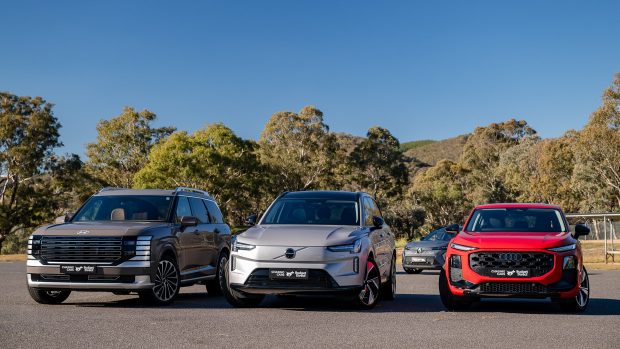
Take the three contenders here – Hyundai, Volvo and Audi. The Germans from Ingolstadt have essentially been doing high-quality cabins since the four-ringed brand was revived in the 1960s, while Volvo has been doing great seats for over half a century, and distinctively designed interiors since at least the ’90s.
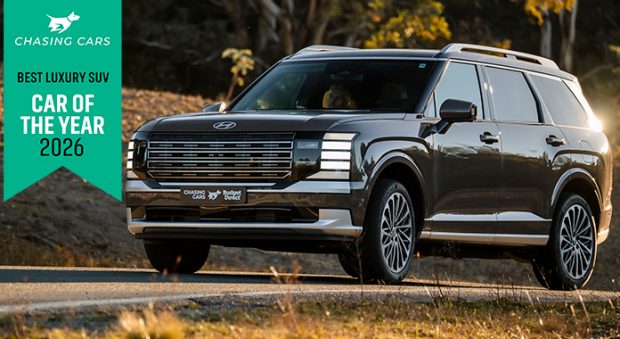
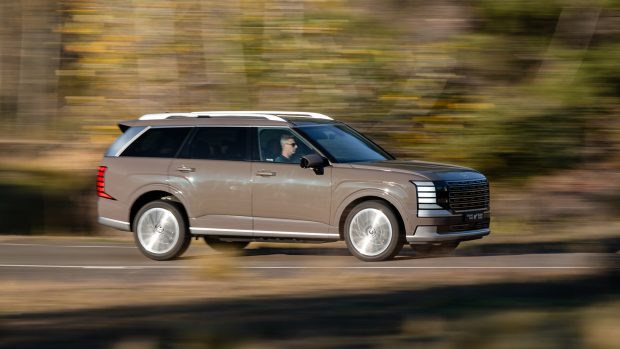
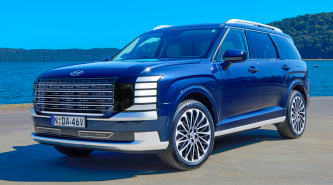
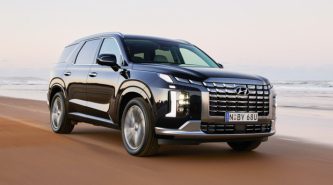
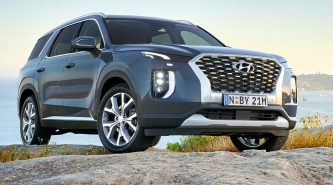
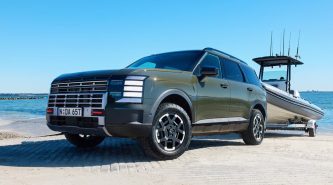
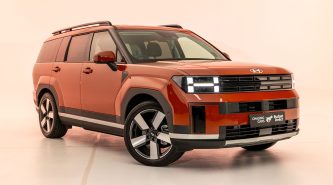
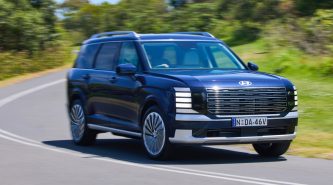
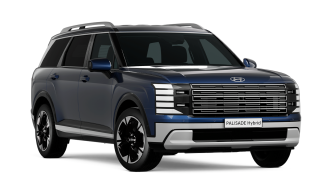
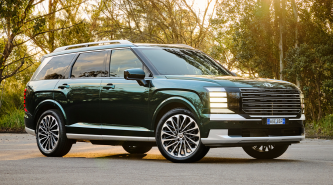
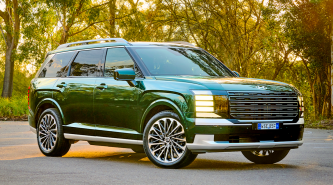
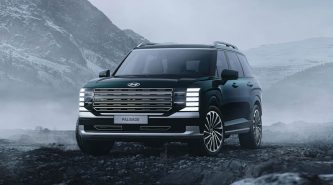
And Hyundai? The 2005 Sonata and big-daddy Grandeur were the first to elevate the Korean marque’s luxury status, however it’s the new-generation Palisade (following on from last year’s COTY-winning Santa Fe) that has introduced genuinely premium levels of refinement and luxury to the brand for a relatively mainstream price.
Want a large, luxurious Volvo or Audi SUV for less than 100 grand drive-away? It’s just not possible…but we know of a certain Korean SUV that may knock your socks off.
What are we looking for in a Car of the Year segment winner? It’s all about performance of intended function — how well a vehicle executes its purpose. Below are the aspects we interrogate.
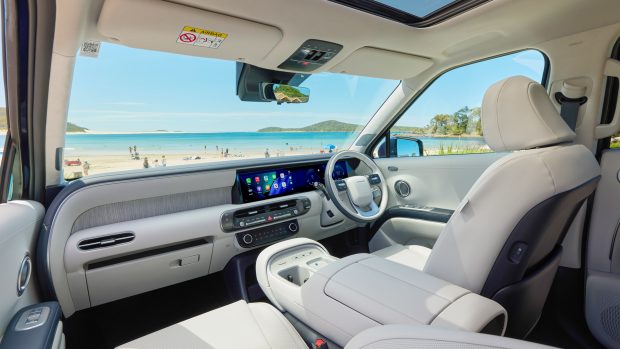
The one thing you can say about the two European luxury contenders in this field is that you can tell where their interiors have been penny-pinched. And that’s certainly not the case with the Palisade Calligraphy. This mainstream large SUV has a Genesis-rivalling level of interior finish and flair that really does look and feel special for $90K.
It’s all standard too, including leather across the dash, doors and centre console, perforated Nappa leather seat upholstery with heating and ventilation in the first two rows, plus heating in the third row, and electric everything – including seat adjustment, sliding and folding.
Following an incident in the US, you now need to hold the Calligraphy’s back-row buttons to electrically stow the backrests away (rather than being one-touch), though this will likely roll out across the world’s entire fleet of fancy SUVs, regardless of brand.
Where the Volvo EX90 offers a modest degree of interior customisation in Australia and seven exterior hues, the Palisade Calligraphy elevates itself beyond the lesser Elite by adding three more interior colour choices beyond all-black – Dark Charcoal with brown stitching, Pure Brown (which is an intense tan), and a Light Grey/Dark Navy combo, all in Nappa richness.
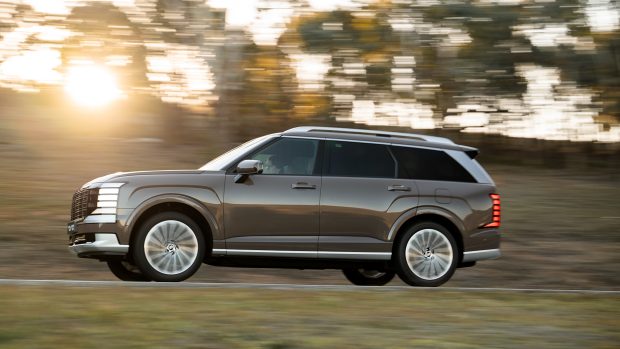
But all the equipment garnish in the world can’t make up for a dud driving experience, and it’s here the Palisade Calligraphy marks its territory with poise, precision, and panache.
Only extremely bad roads provoke any suspension intrusion from the 21-inch wheels, and even then, it’s modest. Otherwise, this genuinely large SUV is effortlessly confidence-inspiring to drive.
The masterstroke of the Calligraphy’s Aussie suspension tune is that it blends self-levelling rear dampers with frequency-selective front dampers to near-perfection. So it doesn’t need expensive adaptive damping or exxy air suspension to help it cope.
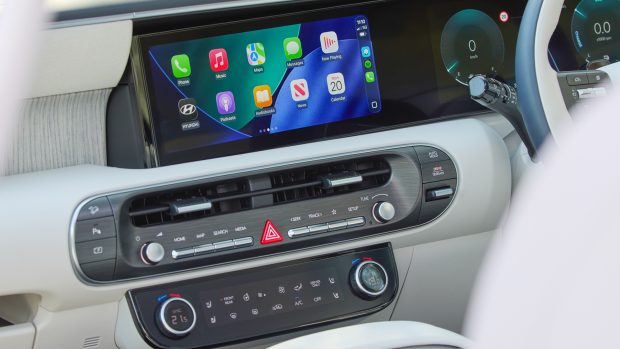
It could be argued that some of the Palisade Calligraphy’s centre-stack switchgear looks and feels ordinary (despite being super-easy to use), however the only real area where it doesn’t quite attain full-luxury status is in its powertrain.
Impressively strong as Hyundai’s flagship series-parallel hybrid set-up is, the 2.5-litre turbo-petrol engine doing much of the heavy lifting under load sounds distinctly like the four-cylinder that it is, rather than a lusty, thrusty, purry V6 that it’s not, but perhaps ought to be.
Two more cylinders in a vee configuration would properly endow the Palisade Calligraphy with the powertrain suaveness it deserves.
That said, the Calligraphy Hybrid’s combination of power, torque and fuel efficiency, combined with the simplicity of an easy-going six-speed, torque-converter automatic, is an admirable one.
What this big Hyundai could learn from the other contenders here is a more nuanced approach to lane-keeping guidance and speed warnings – commensurate with the excellence of its passive-safety performance.
While the Palisade is less annoying than other Hyundai SUVs, and everything is fairly easy to disable, we wish Hyundai-Kia would benchmark a premium European manufacturer for active-safety effectiveness and understand that less is indeed more.
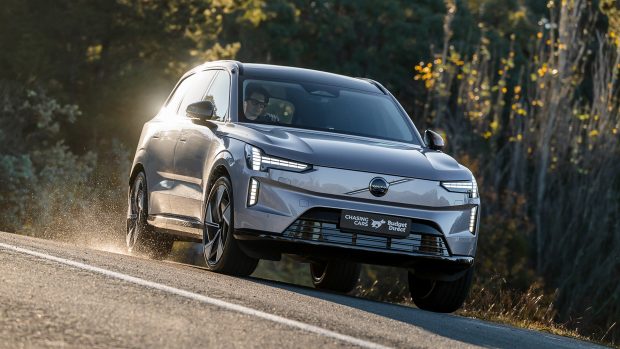
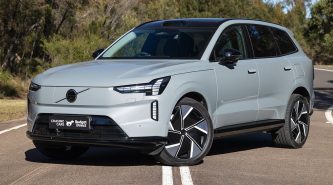
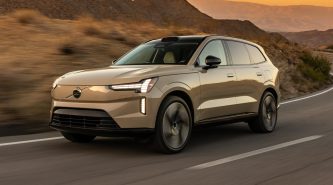
Less than 12 months into its existence in Australia, Volvo’s flagship large electric SUV has already been upgraded with 800-volt architecture and substantial improvements to its charging speed, range and powertrain outputs. It’s now on par with its DNA relative, the Polestar 3, which impressed us hugely during last year’s COTY testing.
In flagship Ultra Twin Motor Performance guise, we’re talking a $135K seven-seat electric SUV with staggering powertrain outputs of 500kW/870Nm, a 0-100km/h claim of just 4.2sec (despite the EX90 weighing almost 2.7 tonnes), a WLTP range of 570km and a 10-80 percent charging time of 23 minutes.
Featuring adaptive air suspension and a dual-clutch, torque-vectoring rear axle, the EX90 Performance is outstandingly agile when push comes to shove, yet rides with reasonable plushness (for the most part), despite wearing huge 22-inch wheels. And it has a stunning 25-speaker Bowers & Wilkins stereo, which turns this Volvo’s seven-seat cabin into a concert hall.
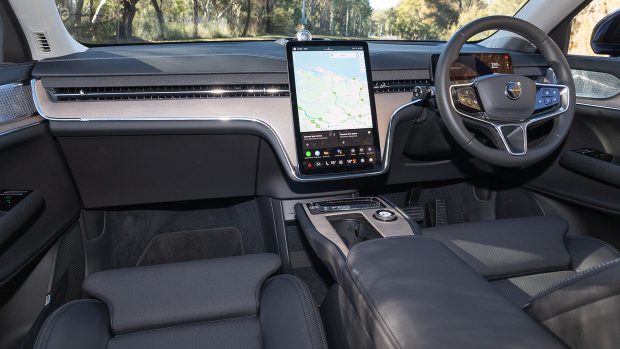
Yet it’s inside where the EX90 doesn’t quite fulfill expectations. There’s a pleasing minimalism to its aesthetic, but it’s taken a little too far with HVAC controls embedded in the touchscreen, buried drive-mode adjustment, cost-cut power window switchgear and a clear step back from the richness of a high-grade XC90 (which is a 12-year-old design) in terms of storage and detailing.
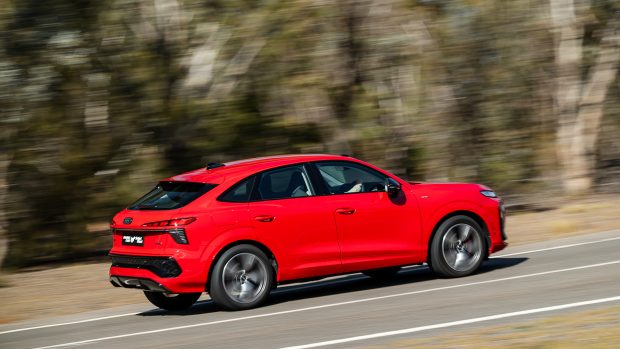
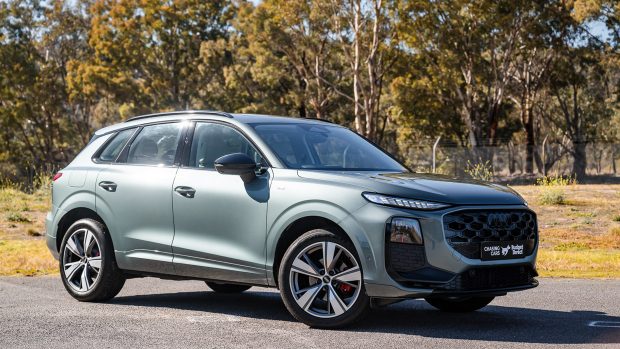
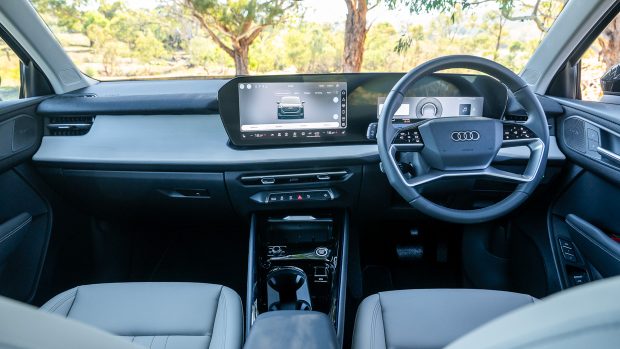
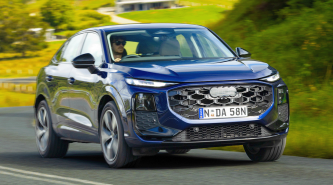
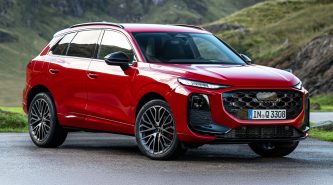
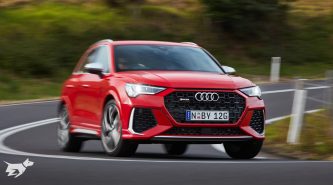
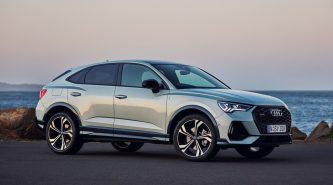
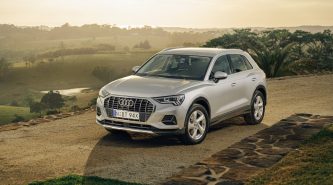
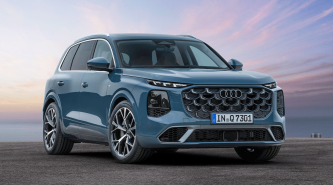
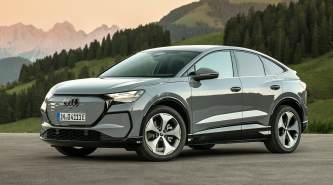
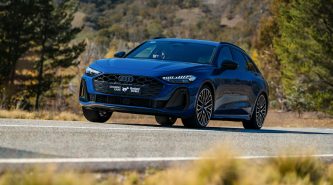
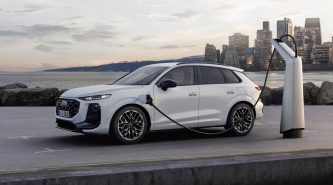
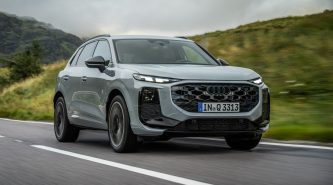
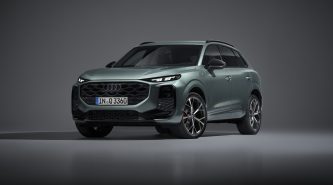
After two generations of expensively crafted Q3 interiors – especially the landmark original from 2011 – the most jarring aspect of the third-generation Q3 is the degradation in its cabin aesthetic and materials quality, especially in terms of consistency.
There are some nice touches (such as the rather confusing, though intriguingly designed steering-column band that replaces traditional column stalks) and some pleasant upholsteries. But many plastics are hard and mismatching, and the curved slab of trim material in front of the passenger (with accompanying lumpy stitching) would look cheap in a $25K vehicle.
The base 110kW powertrain is decently proficient around town and combines with tidy handling, though there’s little performance in reserve. And while the 150kW quattro is better, as well as more involving to drive, both Q3s seem confused – competent in many ways, yet completely undistinguished.
Instead of a leap ahead, Audi’s new-gen Q3 is more of a miss-step.
Latest comparisons
About Chasing cars
Chasing Cars reviews are 100% independent.
Because we are powered by Budget Direct Insurance, we don’t receive advertising or sales revenue from car manufacturers.
We’re truly independent – giving you Australia’s best car reviews.