

Revealed today in Germany, the third-generation Audi Q7 goes into production later this year ahead of a first-quarter-2027 arrival in Australia initially in six-cylinder diesel format.
Audi Australia head of product Matt Dale told Chasing Cars that there will be an orderly transition from the popular second gen’ model to the new car, which nabs boxier styling and a heavily upgraded platform.
The Ingolstadt-based brand has not strayed too far from the familiar Q7 formula, and both launch engines for the large SUV in Australia will be 3.0-litre turbo V6 diesel units.
While the outgoing Q7 gained a four-cylinder engine with its late second facelift, product boss Dale confirmed that the new SUV’s base model will be a V6 once again — this time producing 180kW/500Nm.

Audi Q7 SUV
The entry Q7 will still be capable of towing 3500kg (with 10 percent download limit) and will regain adaptive air suspension as standard, along with 20-inch rims.
From there, the range will move on to what will eventually become the ‘mid-grade’ Q7 S line, has a stronger V6 TDI tune with 220kW/630Nm on tap while adding a standard panoramic sunroof and bigger wheels.
Both versions of the diesel six bundle Audi’s uprated MHEV Plus 48-volt mild hybrid tech that adds a further contribution 18kW/370Nm and an electric compressor.

Audi Q7 SUV
The new Q7 will initially be built only with the V6 TDI engines but the global powertrain menu will rapidly expand, including with a 3.0-litre turbo V6 petrol with a plug-in hybrid system.
For Audi Australia, adding that PHEV into the lineup is a priority thanks to its lower CO2 emissions profile, with Dale confirming it is under close evaluation.
Australia’s tough New Vehicle Efficiency Standard (NVES) laws mean that the emissions advantages banked by the MHEV Plus and PHEV versions of the Q7 are critical to the business case for retaining a V8 model.
At present, the plan is to retain V8 power in the form of a new generation of the SQ7 model, which will likely keep its 4.0-litre twin-turbo engine, albeit with the addition of MHEV Plus tech to cut CO2 by five to 10 percent.
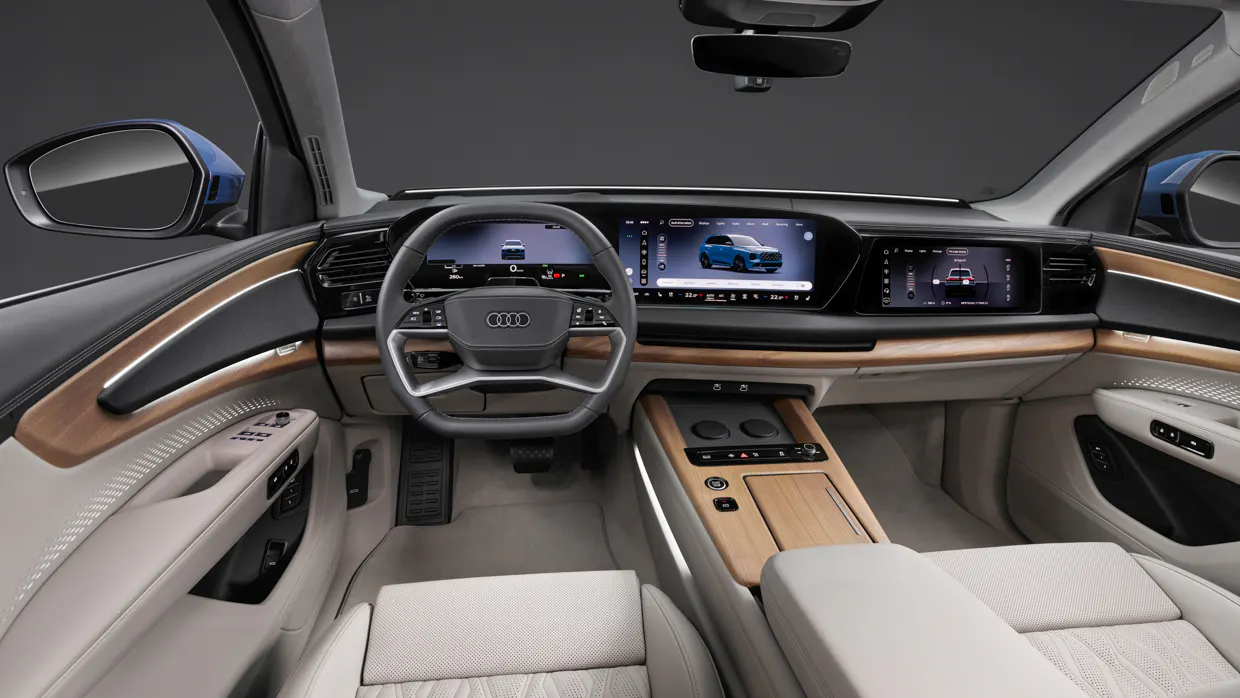
2026 Audi Q7 interior

2026 Audi Q7 rear seat
A petrol V6 is of interest while a four-cylinder will eventually go into production later.
Under the skin, the Q7 moves off Audi’s older MLB longitudinal-engine platform and onto its successor — an upgraded chassis called Premium Platform Combustion that substantially improves the SUV’s electrical architecture.
That will enable smarter driving assistance tech, more efficient drivetrains and better packaging than the outgoing Q7.
Beneath squarer and more upright styling cues that builds on the aesthetic debuted by the smaller Q3 model, the Q7 will now be available with five-, six-, or seven-seat configurations.
While the outgoing model could always be special-ordered with five seats, the seven-seater will continue as the default but a six-seater with central captain’s chairs will be an interesting option, especially for chauffeur-driven fleets.

2026 Audi Q7
Exterior styling is evolutionary, but the cabin gets a complete change, adopting the same language as the Q5 and A5 models with a large, curved OLED panel ahead of and next to the driver.
New seats offer extensive adjustment, heating, ventilation and massage, while thoughtful touches include dual MagSafe-equipped wireless device chargers that hold compatible phones strongly in place.
Perceived quality has improved over the outgoing car —and other recent Audi efforts — with a test car shown to Chasing Cars fitted with expansive soft materials, including stitched leather on the dash, door tops, steering wheel boss, and knee pads.

2026 Audi Q7
Options like digital matrix LED headlights, third-generation OLED taillights (that can be animated in motion), a lit grille and 4D Bang & Olufsen stereo will all be on the menu.
The Q7 will no longer be Audi’s flagship SUV model. The incoming Q9 model, which will also come to Australia, means the five-metre Q7 has been able to retain similar sizing to the outgoing car.
Chief rivals will continue to be the BMW X5 and Mercedes-Benz GLE, as well as new segment entrants like the Zeekr 8X.
Detailed specifications and Australian pricing is expected to be announced towards the end of this year.