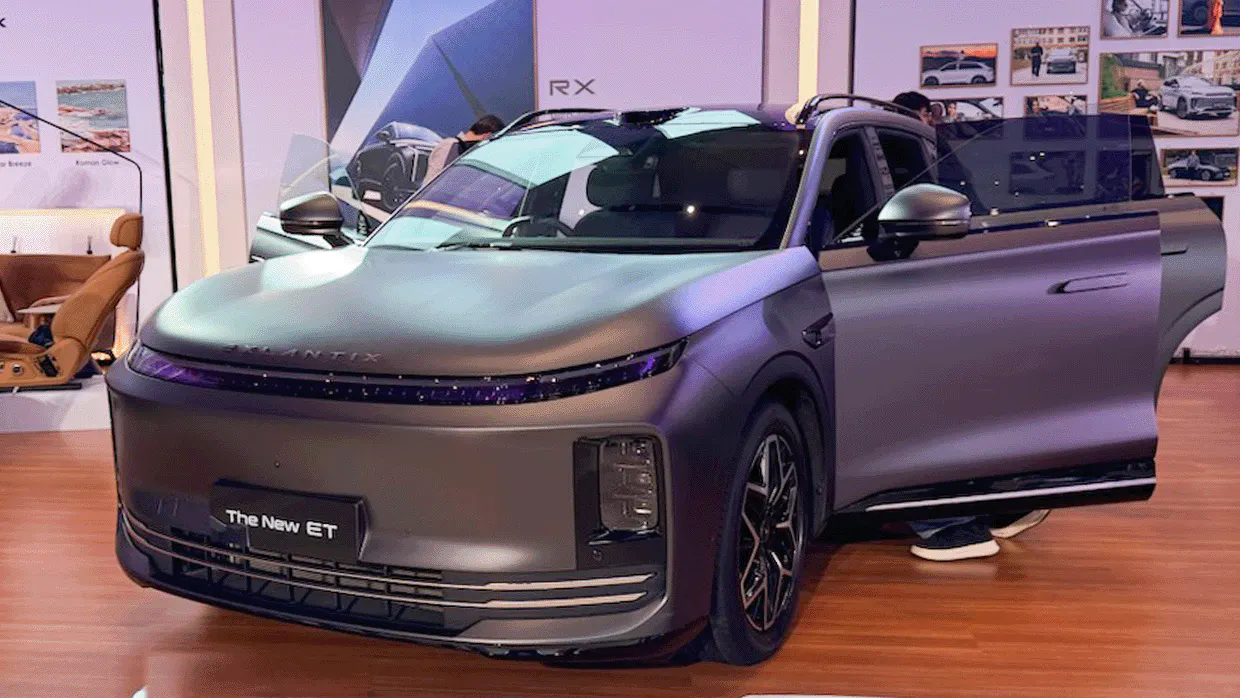


This December marks the return of a competitor the likes of Toyota, Nissan and Ford have not needed to fear for half a decade.
While the previous Pajero was often compared with the full-size Toyota Land Cruiser and Nissan Patrol wagons, the fifth-generation 4WD will be priced similarly to the popular Ford Everest and Toyota Prado.
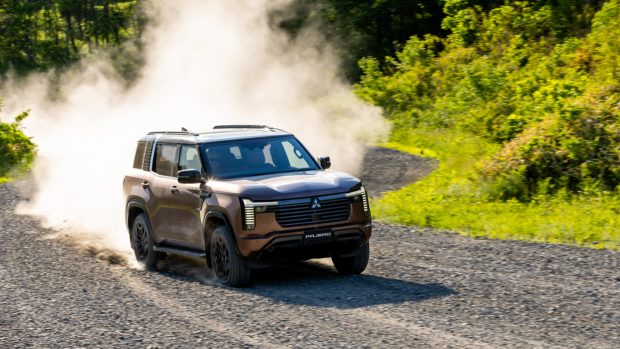
A comprehensive comparison will have to wait until Chasing Cars finally gets behind the wheel of the new Pajero on Australian soil, but for now, let’s look at how Mitsubishi’s new-generation 4WD stacks up on paper against its rivals.
Engines and drivetrains compared
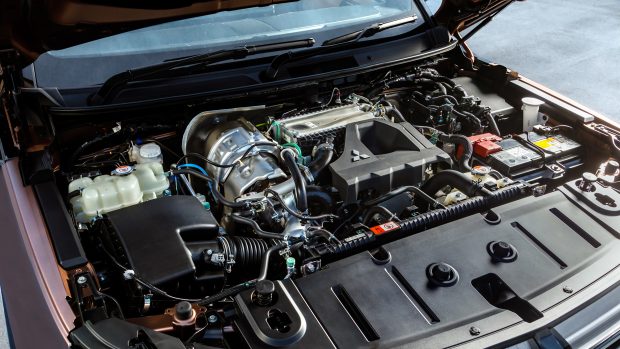
Under the skin of the new Mitsubishi Pajero is a 2.4-litre four-cylinder turbo-diesel engine derived from the Triton, though it’s referred to as a ‘second generation’ engine and features a single, variable-geometry turbocharger instead of the Triton’s twin-turbo set-up. It also produces slightly more torque at 480Nm (though the same 150kW of power).
It’s coupled to a newly developed eight-speed automatic transmission and Mitsubishi’s Super Select II 4WD system, which can engage 4-High on sealed surfaces.
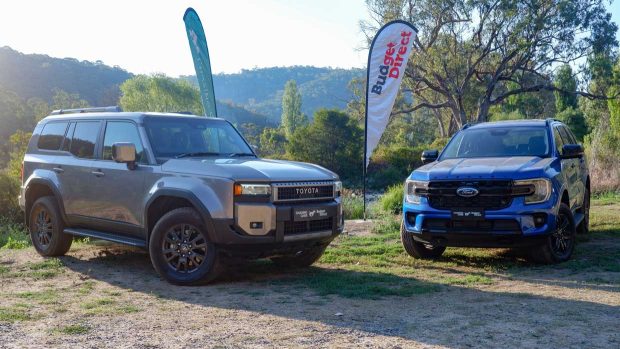
The Ford Everest is available with either a 125kW/405Nm 2.0-litre turbo-diesel four-cylinder or a 184kW/600Nm 3.0-litre turbo-diesel V6, both coupled to a 10-speed automatic transmission, though the former lacks the ability to engage 4H on sealed surfaces, unlike the V6.
Toyota’s Prado uses a 150kW/500Nm 2.8-litre turbo-diesel four-cylinder paired with a 48V mild-hybrid system, eight-speed automatic transmission and a full-time 4WD system.
All three are rated to tow 3.5 tonnes with a braked trailer.
How capable are the Pajero, Everest and Prado off-road?
All three 4WD wagons feature a low-range transfer case, with the Pajero and Everest equipped as standard with locking rear differentials. The Prado only features a locking rear differential on the top-spec Altitude, which also gains a disconnecting sway bar for better wheel articulation.
The Pajero boasts 230mm of ground clearance, compared to the Everest’s 229mm and Prado’s 210mm on most grades – though off-road specialist grades do offer more.
Mitsubishi claims approach, breakover and departure angles of 30.4, 22.6 and 25.8 degrees respectively. The Everest’s equivalent values are 30.4, 25.3 and 25.3 degrees; and the Prado’s are 31.0 approach and 17.0 departure angles on the GX and GXL, with a breakover not quoted by Toyota.
Wading depth figures for the new Pajero have not yet been disclosed, but the Everest touts an impressive 800mm limit, while the Prado is limited to 700mm.
How much do the Pajero, Everest and Prado cost in Australia?
At launch, the Pajero range will kick off with the historically mid-spec GLS priced from $68,490 (before on-road costs), meaning the cost of entry is a bit higher than rivals until the expected GLX follows at a later date. The seven-seat GSR forms the ceiling at $84,990.
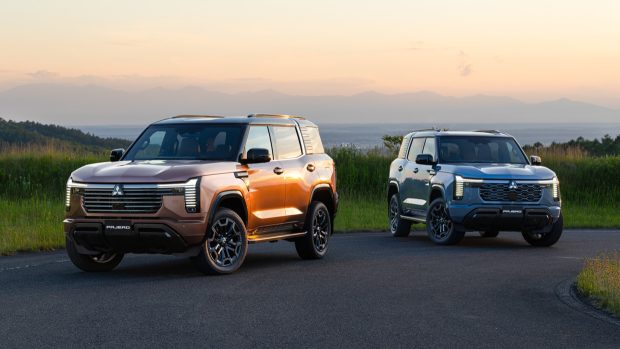
The Everest kicks off from $58,990 for the 2.0TD Active, and tops out with the 3.0L V6 Platinum at $82,917. The Prado starts at $73,200 for the GX and tops out at $94,330 for the Altitude.
What do the Pajero, Everest and Prado include for the price?
As mentioned above, the Pajero lacks any ‘true’ base model at launch, so the line-up is comparatively modest for the time being.
Therefore, the entry-level GLS is well-equipped, featuring LED headlights and tail-lights, roof rails, rear privacy glass, side steps, twin 12.3-inch screens, cloth upholstery, a six-speaker stereo, wireless phone charger, power tailgate and more.
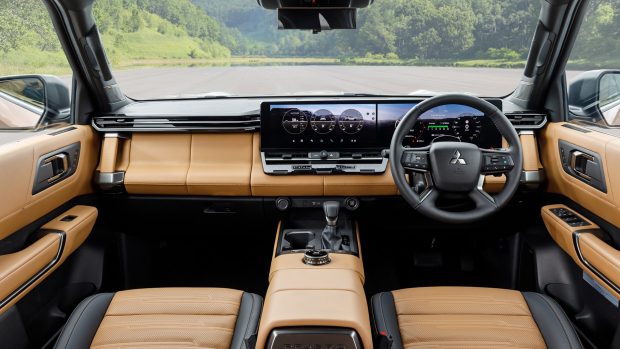
Higher grades swap in or add the following: 20-inch alloy wheels, leather upholstery, twin 14.3-inch screens, a 12-speaker Yamaha stereo, heated seats front/rear, front seat cooling, power steering column adjustment and a panoramic sunroof.
The Everest Active is equipped with LED headlights and tail-lights, cloth upholstery, a wireless phone charger, an eight-speaker sound system, a 12.0-inch portrait touchscreen, an 8.0-inch digital driver’s display and more.
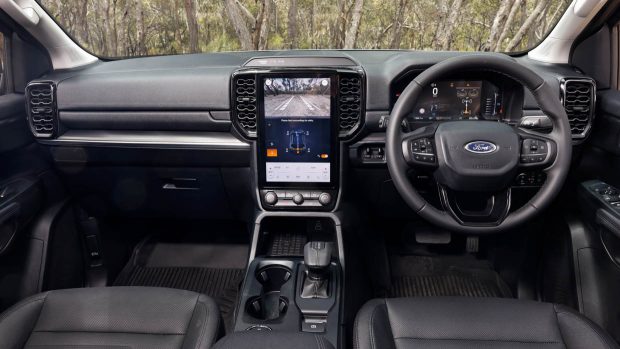
It misses out on features like roof rails and a power tailgate but the biggest issue is the underpowered single-turbo four-cylinder fitted as standard. You can opt for the Active V6, but that’s going to cost an extra $8K.
Higher grades get the V6 diesel by default, along with features like a 12.0-inch digital driver’s display, 400W built-in inverter, matrix LED headlights, Nappa leather upholstery, heated/cooled seats, wheels up to 21-inches in size on the Platinum or even lifted Bilstein suspension on the rugged Tremor grade.
The Prado GX is fitted as standard with a 12.3-inch multimedia screen and a 7.0-inch digital driver’s display, side steps, LED headlights and tail-lights, 10-speaker sound system, urethane steering wheel and cloth upholstery. No roof rails, privacy glass or even tyre-pressure monitoring can be found on the base grade.
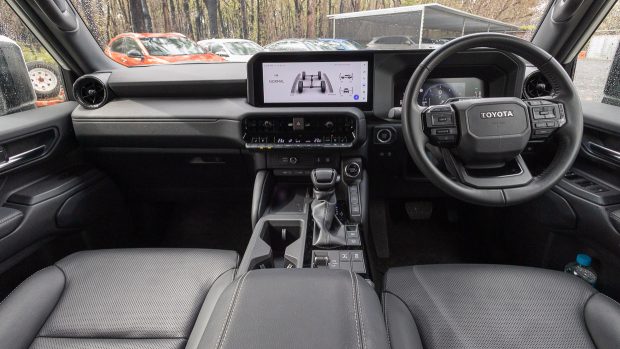
Upper trims feature a larger 12.3-inch digital driver’s display, a 14-speaker JBL stereo, bi-LED headlights, a panoramic sunroof, full leather upholstery, and, impressively, heated and ventilated seats in the first and second rows.
So who wins?
Without driving it in Australia, we can only say that the Pajero looks promising.
Mitsubishi has built a legacy of offering decent bang-for-buck, but in recent years, below-par execution and cost-cutting have tarnished what could be solid offerings from the brand, as highlighted starkly by its alliance partner Nissan, which has often developed superior vehicles from the same fundamental platform.
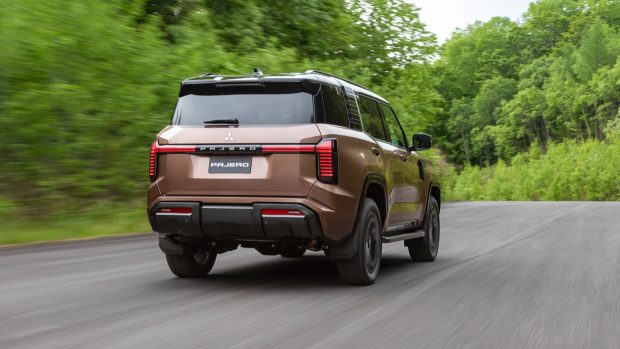
Mitsubishi insists the incoming Pajero will not just live up to the nameplate but take it to new heights and has come armed with a set of impressive engineering figures – and now price tags – to show that it means business.
The Everest and Prado currently offer more choice, are generally well-established and well-executed offerings in the market, but the Ford offers an anemic engine in the base grade, and the Toyota is expensive.
Mitsubishi is banking on the power of the Pajero nameplate to get buyers through the door, but it will also raise expectations the brand needs to deliver on.