Powered by

-
Car Reviews
Latest reviews
-
Car News
Latest news
-
Car Comparisons
Latest comparisons
- Chasing Deals
Latest reviews
Latest news
Latest comparisons
As the Genesis brand fights for a foothold in the luxury market, only the GV70 has won over the hearts and minds of Aussie buyers. We’re going to find out why
Spun off from Hyundai’s ‘Genesis’ limousine into a standalone nameplate in 2015 before making its local debut in 2019 with the G70 sedan, the budding luxury brand from Korea should be hitting its stride right now, but when will Genesis have its revelation?
While it passed the one million global sales milestone in 2023, fast forward to 2025 and things are less rosy here in Australia, with just 1178 registrations recorded as of September. That’s an increase of 8.9 percent, but it’s also a drop in the ocean compared to segment leaders BMW (20,301) and Mercedes-Benz (17,150), along with Audi (11,001) and Lexus (10,867).
To be fair, luxury segments are historically ruthlessly difficult to break into, with badge loyalty not just an obstacle to overcome, but a tool to harness long-term success. The Australian market has arguably never been so congested and competitive, either, with newcomer Zeekr already clocking up 730 local registrations after barely a year since its introduction.
Perhaps more concerning is the fact that only one model is doing all the legwork at Genesis: the GV70 midsize SUV. Everything else, including the fully-electric GV60 midsize SUV, the recently updated GV80 large SUV and the G70 and G80 sedans, have all declined in sales.
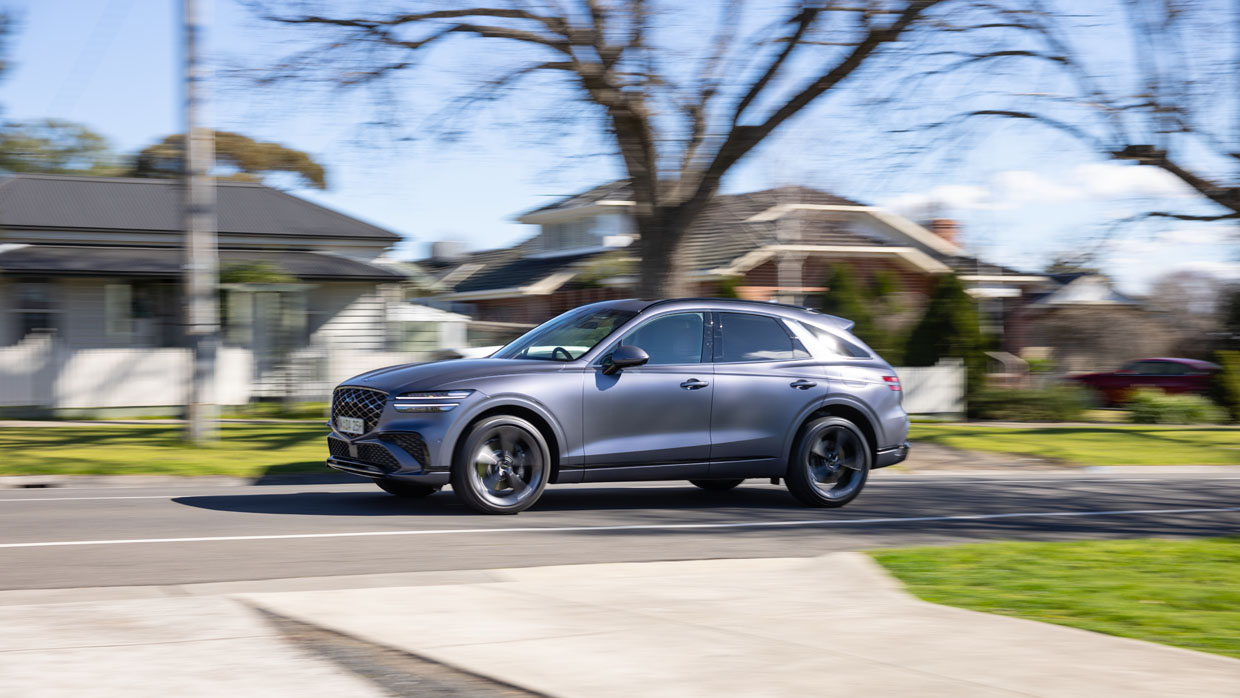
But the GV70 is clearly running its own race, with sales up 56 percent so far this year. Its owners aren’t fools either; this midsizer has generally held up well under our previous assessments – but the sales pitch hasn’t been without its drawbacks.
The GV70 package is said to have improved with the facelift applied at the end of last year and yet pricing still remains enticing compared to rivals such as the BMW X3, Mercedes-Benz GLC, Audi Q5, Volvo XC60 and many more.
It’s for that reason, among others we shall now discuss, that we’ve decided to take one on for a gruelling six-month review.
Many buyers will care little for the raw athleticism of the twin-turbo V6 in our GV70, so why bother when the cheaper four-cylinder is available?
Having just discussed the most expensive version of the GV70 available, it’s time to weigh up the cheapest.
With RWD versions stripped from the range in recent years, prices kick off at $80,300 before-on roads for the AWD Advance, with the base 2.5-litre turbo four-cylinder engine.
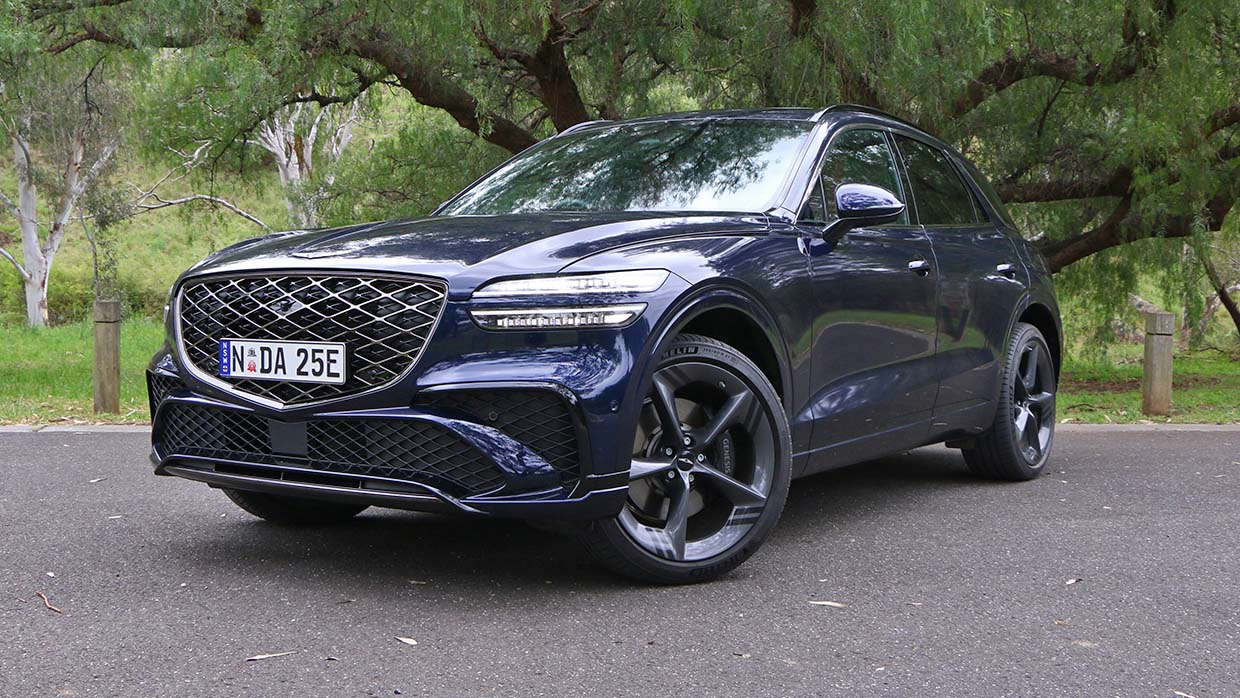
Although not as popular as our 3.5T Signature Sport, which soaks up 34 percent of sales, the AWD Advance still accounts for some 20 percent of buyer take-up and is earmarked by Genesis Australia as the model’s next big target for sales growth.
Value is still strong at this level with the following standard features:
Disappointingly, only the highly specified 2.5T Signature Sport ($91,300) was available for loan during our long-term tenure but in some ways it was a blessing in disguise, as it allowed us to properly compare these two engine options without distraction in terms of spec.
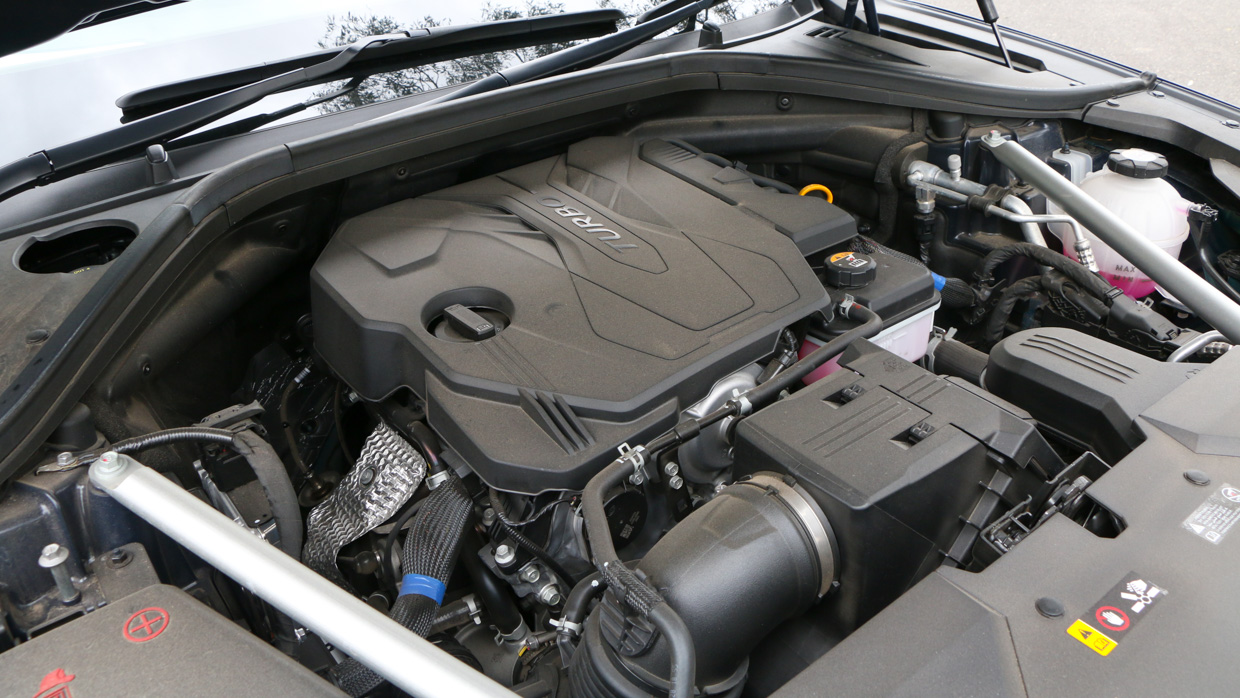
A not insignificant $10,500 difference separates the four- and six-cylinder engine options, so is the latter worth the cash or simply unnecessary for most buyers? Let’s take a look.
Jumping into the 2.5T from our long-term V6, first impressions are certainly good. Power and torque are perfectly adequate, with a peak of 224kW/422Nm versus 279kW/530Nm in the 3.5TT, and the eight-speed torque converter automatic shared between them makes good use of what’s on offer.
The four-pot feels torquey around town and remains so as you climb towards highway speeds. It’s not fast, but nor would you expect it to be; this is the base engine.
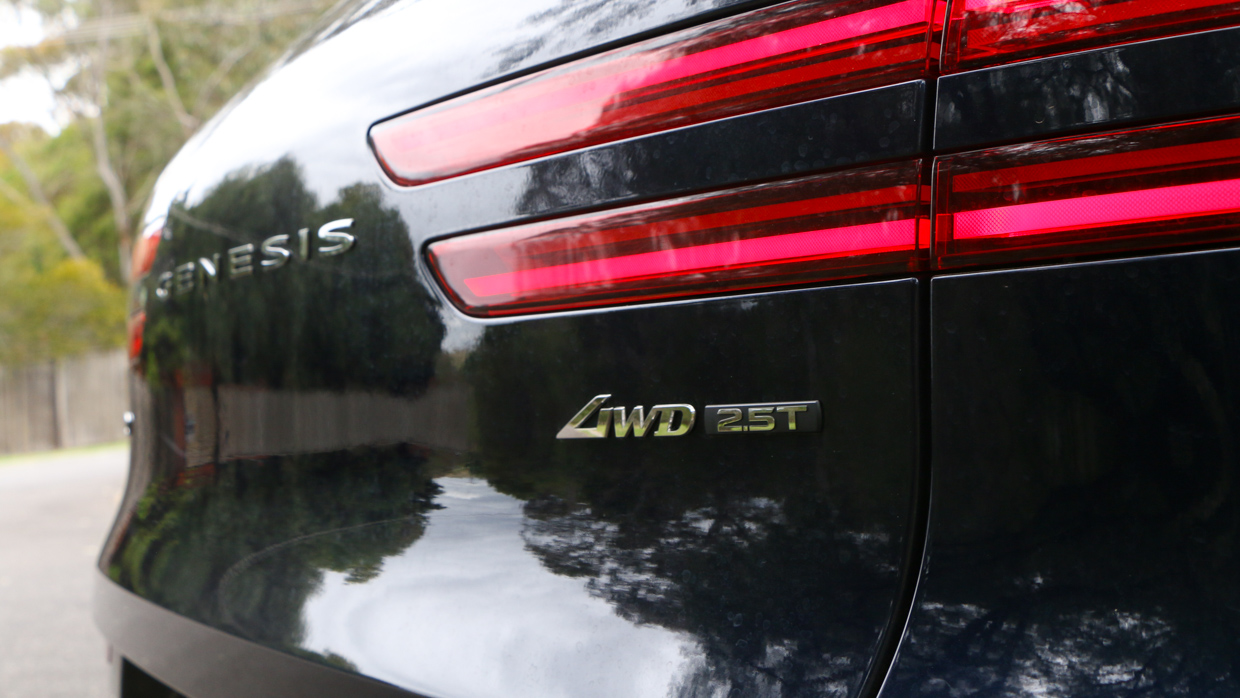
With one turbocharger rather than two, and less displacement and cylinders to share the load, the 2.5T certainly feels more peaky and less refined to drive than the V6. Still, nothing of huge consequence just yet.
Dynamically, the 2.5T affords the GV70 a greater turn in, courtesy of the 75kg weight reduction that brings the mass down to 2013kg (tare).
It’s a shame that benefit doesn’t follow through to a better driving experience and the reason has more to do with the suspension than it does the engine, with the 2.5T paired exclusively with passive dampers rather than the road-scanning adaptive trickery found on the V6.
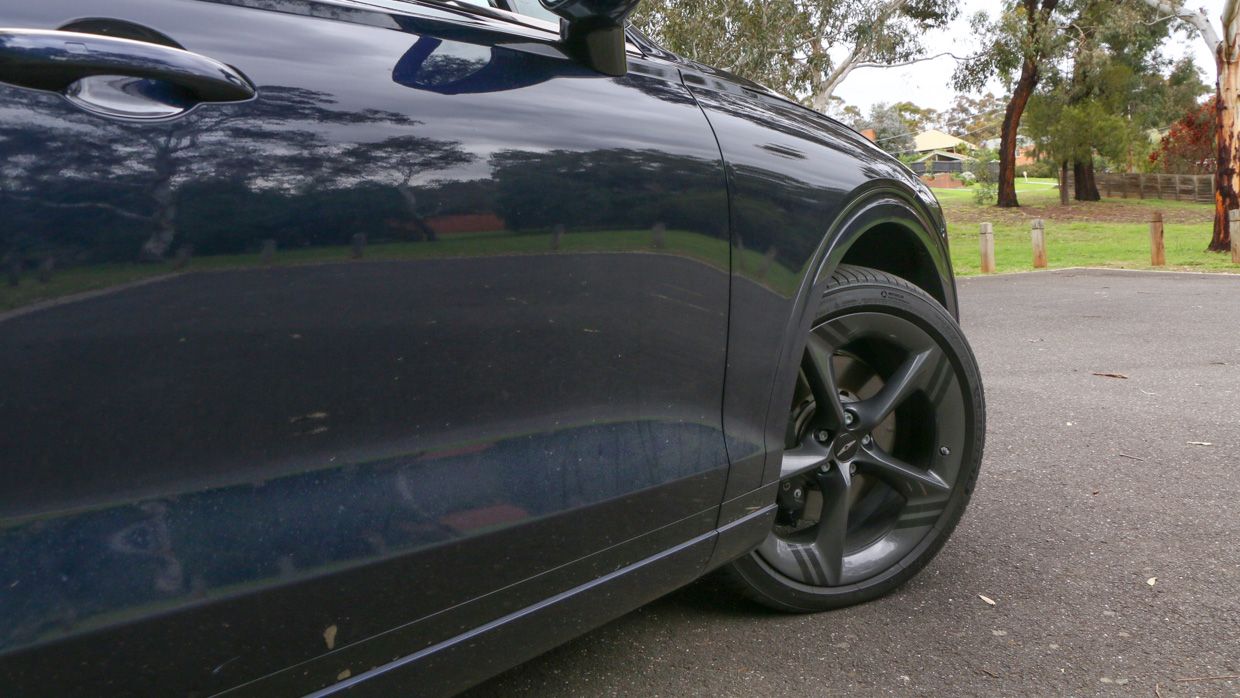
Although a marketed improvement over the extremely brittle-feeling setup of the pre-facelifted GV70 in four-cylinder guise, it’s still not good enough. The suspension feels harsh over moderate road imperfections and often takes two to three rebounds to settle over a large pothole or speed bump.
It strips away any confidence or desire the driver might have to explore the dynamics of the 2.5T and that really is a shame.
Perhaps things might be better on the Advance with its smaller 19-inch wheels and thicker 235/55 side walls against our as-tested 255/40R21, but then you forfeit the sharp looks and luxury upgrades of the popular Signature Sport grade.
What about fuel economy then, surely the four-pot is better than the thirsty V6? On paper, yes, with a claimed 10.3L/100km in combined conditions, versus 11.3L/100km for the V6. But, in our week at the wheel, we found it recorded similar real-world consumption of 12.5L/100km.
Perhaps if Genesis offered the V6’s superior suspension setup on the four-pot our feelings might be different but that’s currently not the case; from heavy city traffic during the week to flowing b-roads on the weekend, our sweet six is still the clear preference in this range.
Next month, it’s time to bid farewell to our GV70 and provide our final verdict.
Two seemingly identical cars, one petrol and one electric, the latter quicker while wafting along in luxurious silence – but is the EV the better overall car?
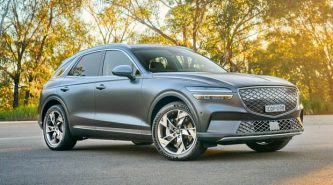
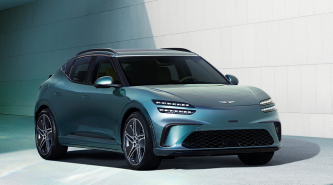
Sometimes it’s clearer than others that car names are dreamt up for algorithms rather than humans, and the Genesis Electrified GV70 is one such example.
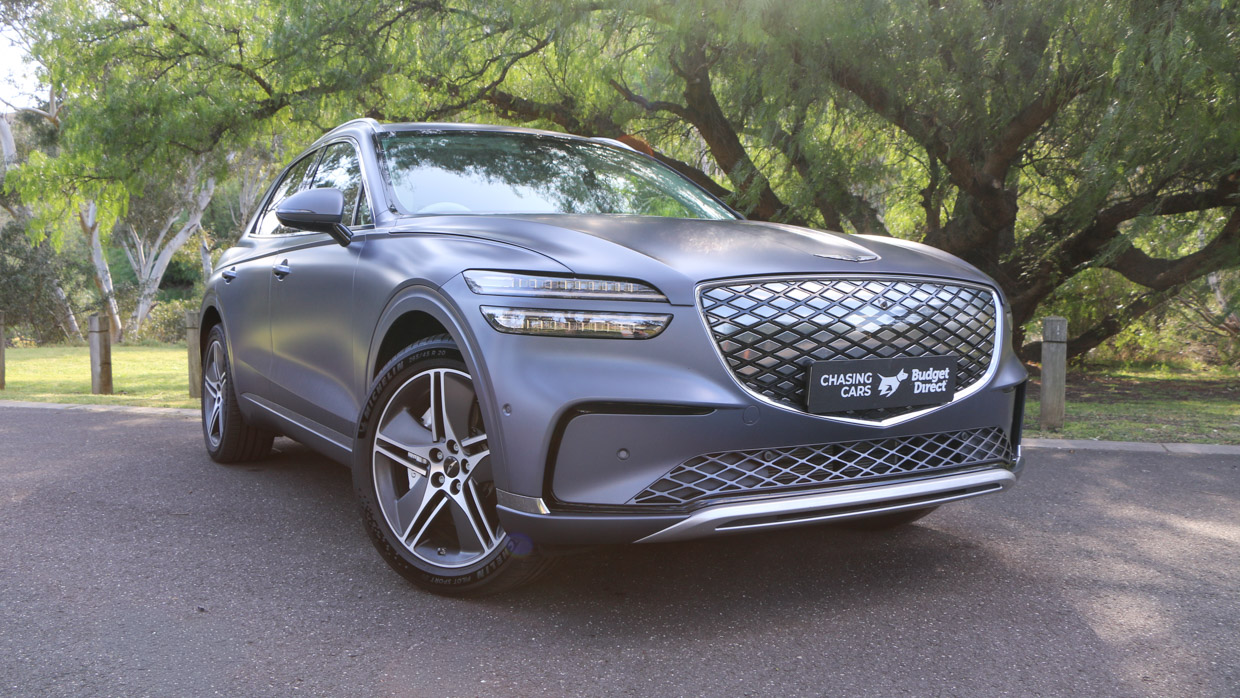
For starters, the Electrified trips almost everyone up, given that it’s placed before GV70 in the name rather than, more conventionally, behind. It also somewhat undersells this BEV’s premise, as ‘electrifying’ something applies to the most meagre of 24-volt mild-hybrid systems, all the way to fully electric vehicles such as this.
It’s a bit like branding an elite powerlifter as ‘pretty strong’.
We hate the name but there is some truth to it as, unlike the sibling GV60 midsize (a ground-up EV on the dedicated E-GMP platform), the GV70 has been given a spark-for-a-heart in a retrofit fashion, using the existing combustion platform. It’s quite literally been ‘Electrified’ from ICE roots.
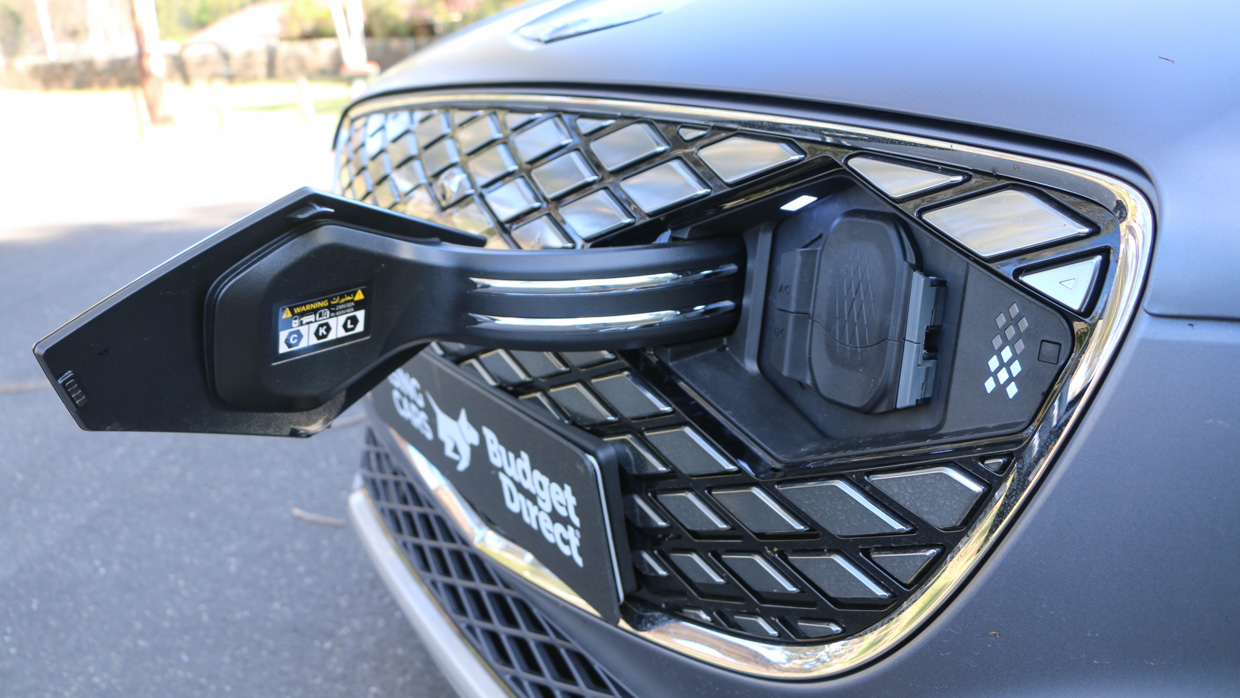
This practice is gradually being phased out as a given dual-drivetrain platform usually sees compromise to one or both powertrain applications, and the headline 462km range claim (WLTP) suggests the GV70 hasn’t escaped such truths.
To be fair, the Electrified GV70 isn’t a cutting-edge EV in 2026 given that it came out in 2022, but electric tech moves quickly, with the new-generation BMW iX3 and Mercedes-Benz GLC EV set to land Down Under this year with range claims of 805km and 713km (WLTP), respectively.
Is this Genesis dead and buried then? Perhaps, but even with the $144K driveaway price – some $34K higher than our V6TT-wielding long-termer – it’s likely to be cheaper than the Merc or Beemer. A comparison with the emerging Germans will have to wait for another day.
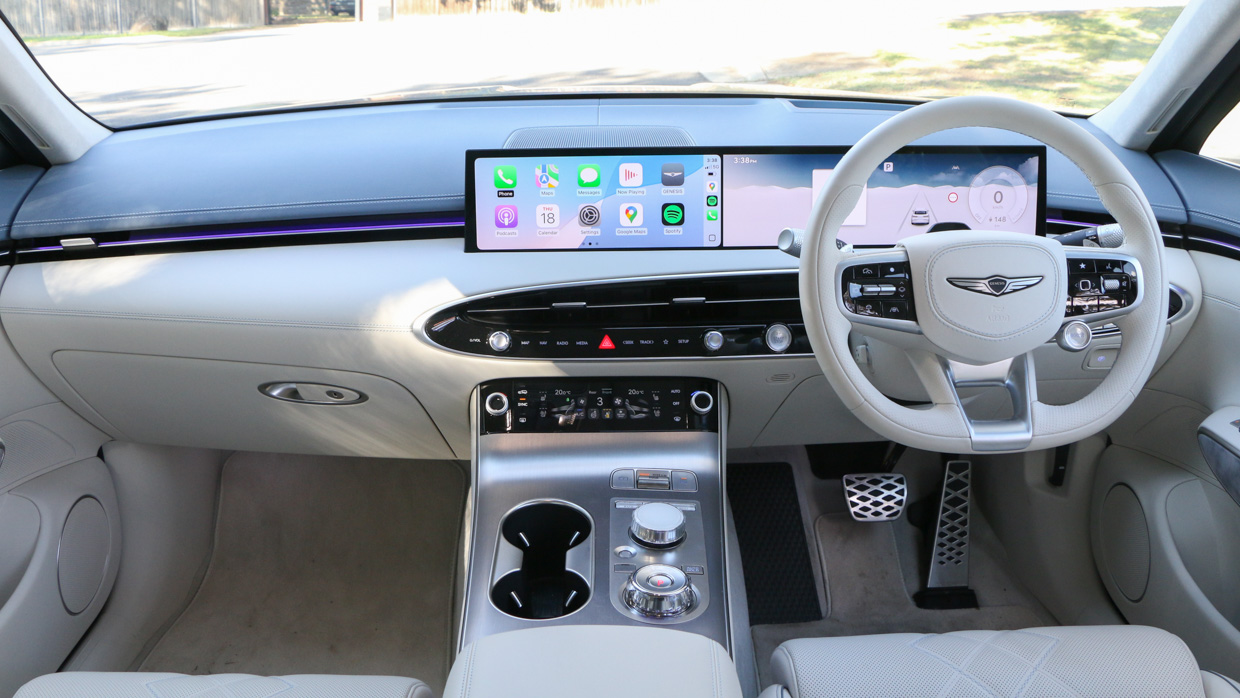
Looking back inward for a moment, though, could the best GV70 be sitting right at the top of the range in this Electrified form? There are some reasons to believe this is the case – many actually – so let’s go over them one by one.
As you would imagine, the Electrified GV70 (referred to as the GV70 EV from here on) is noticeably quieter than the twin-turbo V6, itself a well-mannered unit until its 279kW and 530Nm peaks are called upon.
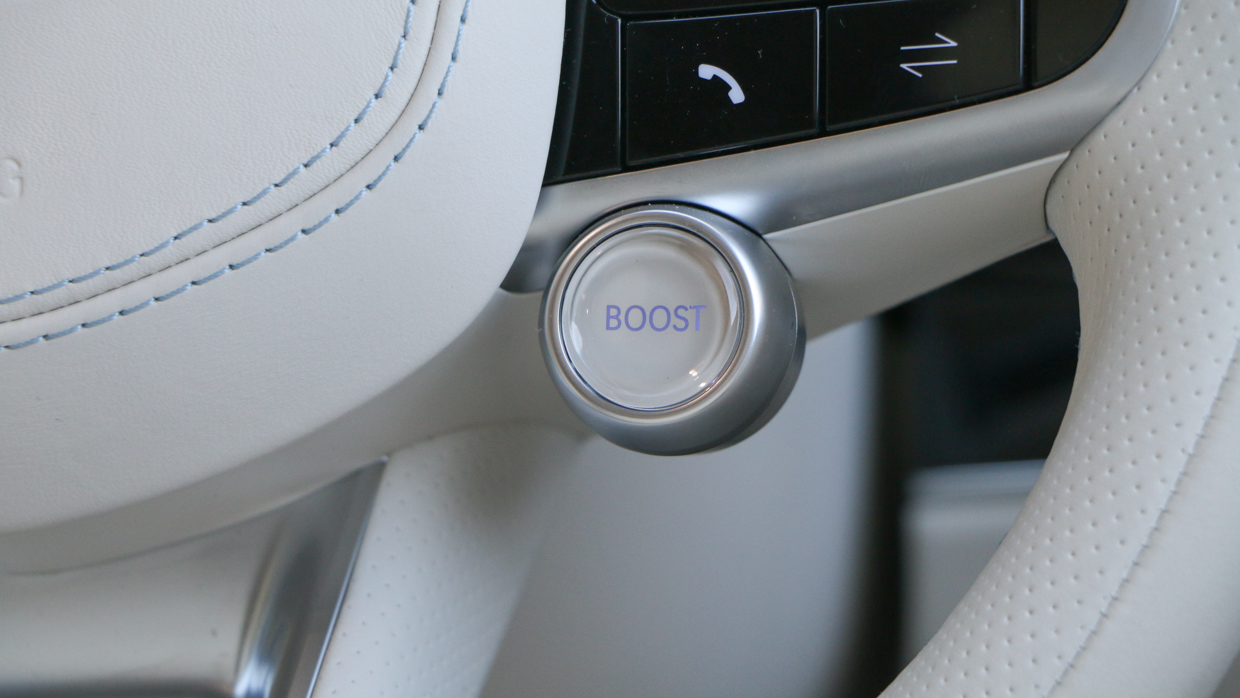
Those figures are dwarfed by the 360kW/700Nm of the GV70 EV, and the 4.4-second 0-100km/h sprint feels every bit quicker than the V6’s 5.2sec effort. But the pendulum swings the other way once you reach the first corner.
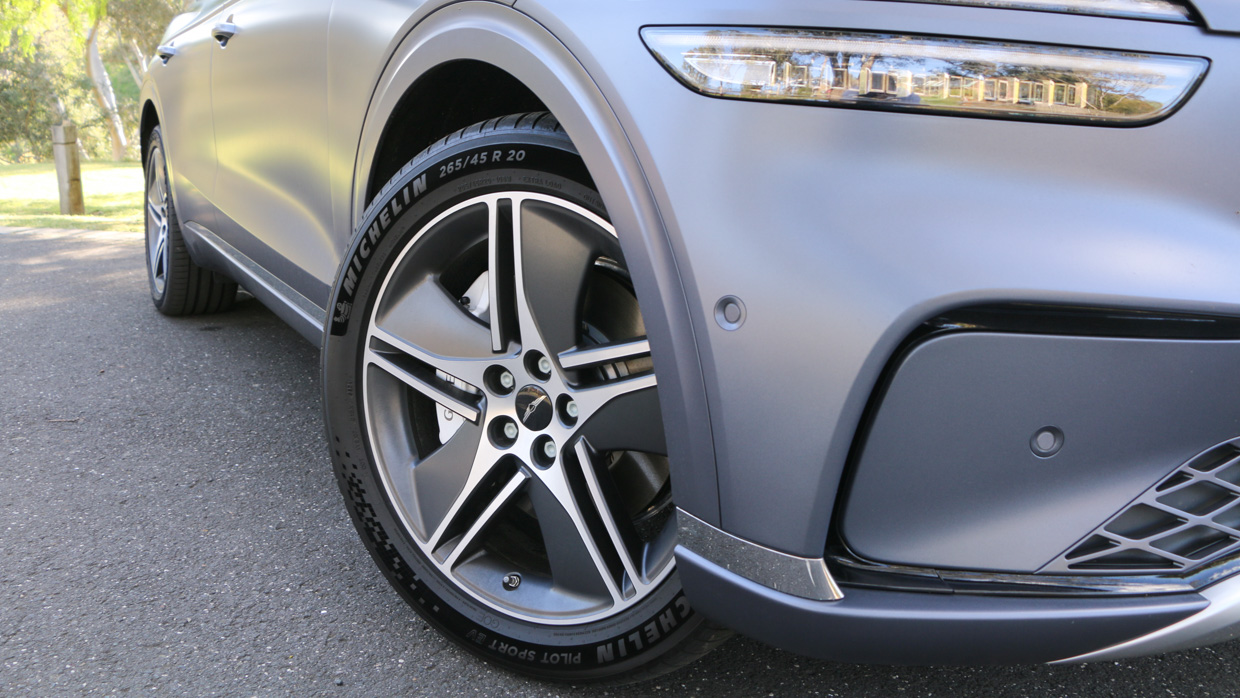
Although the front end bites harder on the turn-in and the body control is slightly better, the 242kg weight disadvantage of the (2340kg) EV dampens the athleticism and fluidity of the petrol GV70. Over a full lap of a racetrack, it’s no doubt the faster car, but there is some joy lost with the EV version, and that’s a shame.
Even in everyday driving, the general calibration for the EV just isn’t as accomplished as the petrol’s. Remember that beautifully progressive throttle feel we spoke about in Month 2? The EV trades this mannerism for a far more aggressive approach, requiring an especially delicate touch when reversing uphill.
With firmer suspension designed to support the extra quarter-tonne of heft, Genesis has wisely downsized the 21-inch wheels equipped on much of the range for more appropriate 20s with slightly more sidewall to cushion the ride.
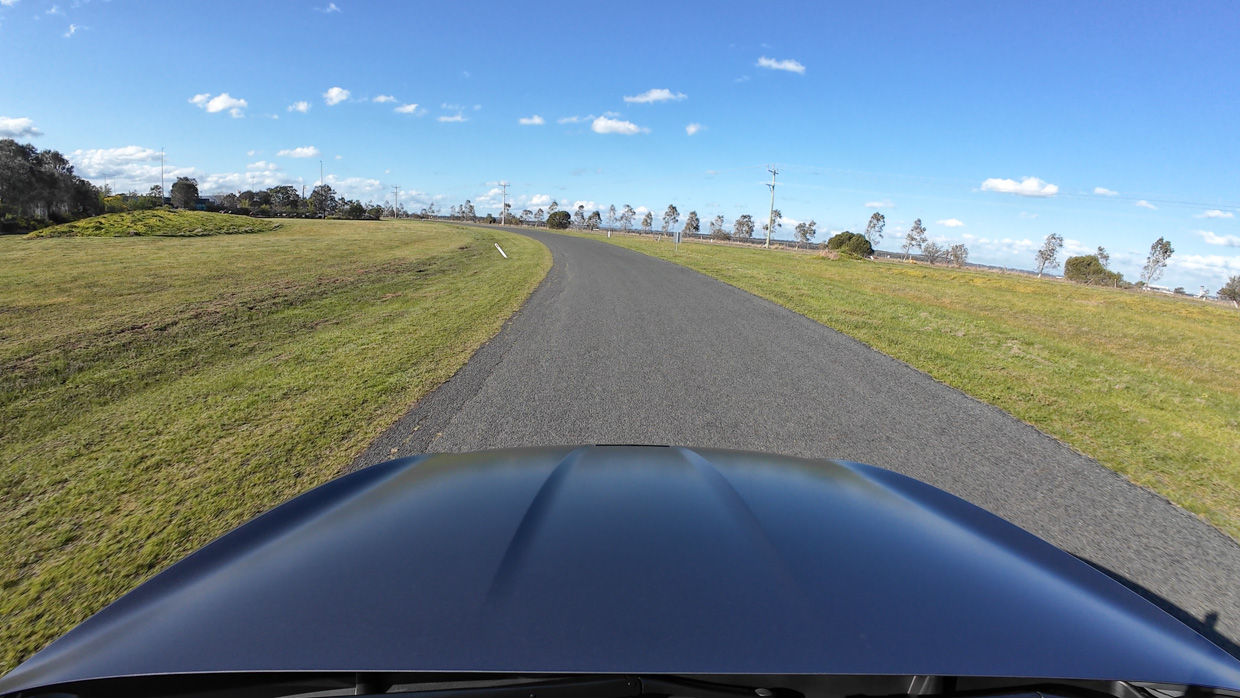
The end result is not as compliant and lush as our V6, but it’s by no means uncomfortable. Even still, you’d hope it would be better than the petrol for the Suzuki Jimny-sized premium you’re paying.
The smaller wheels are one of the few exterior changes made to the EV version, aside from a more futuristic closed-in grille design, with the interior largely the same – save for the ‘Boost’ button on the steering wheel to unlock its full might.
But that in itself has its own appeal, as Mercedes-Benz has learnt recently with its distinctive EQ egg-shaped vehicles; many buyers looking into new cars with electric drivetrains don’t necessarily want to make a fuss about it in design presence.
Taken in isolation, the Electrifed GV70 is a lovely thing and for those looking for a point-and-shoot commuter its meagre official 462km range claim may be of little consequence. We saw closer to 400km in our testing, which would make for a nerve-wracking experience on weekend road trips.
But with the V6 so well mannered already and the step up to electric so steep, it needs to do more to win this argument.
For every small step up in luxury thanks to a more hushed cabin, there’s a bigger step down in ride comfort and general usability – it also forgoes the petrol’s spare wheel that some readers may recall saved me a few months back.
In our view, those looking for an electric midsize SUV currently should either consider the significantly cheaper GV60 or simply wait for future rivals from BMW and Mercedes, as right now the most expensive GV70 seems to be the least convincing.
She’s a pretty thing, our GV70, but family life is a thankless and grubby task for all SUVs – time to get some dirt under those fingernails
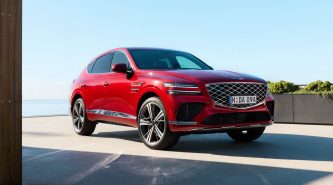
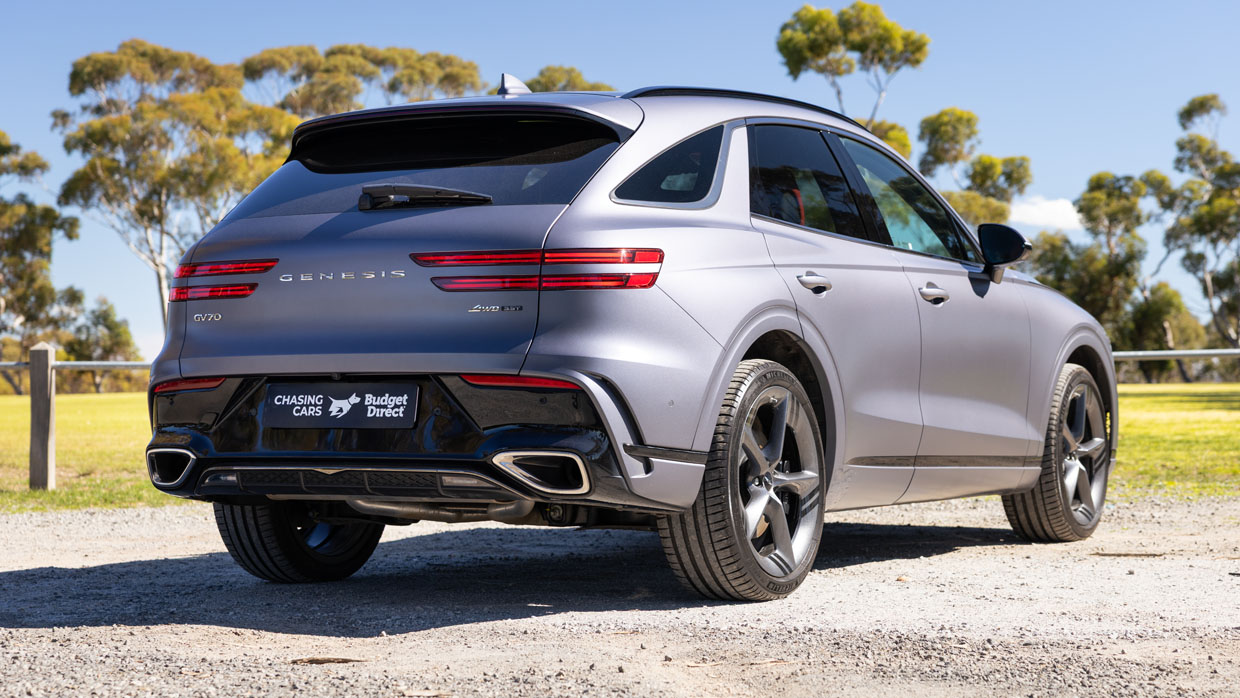
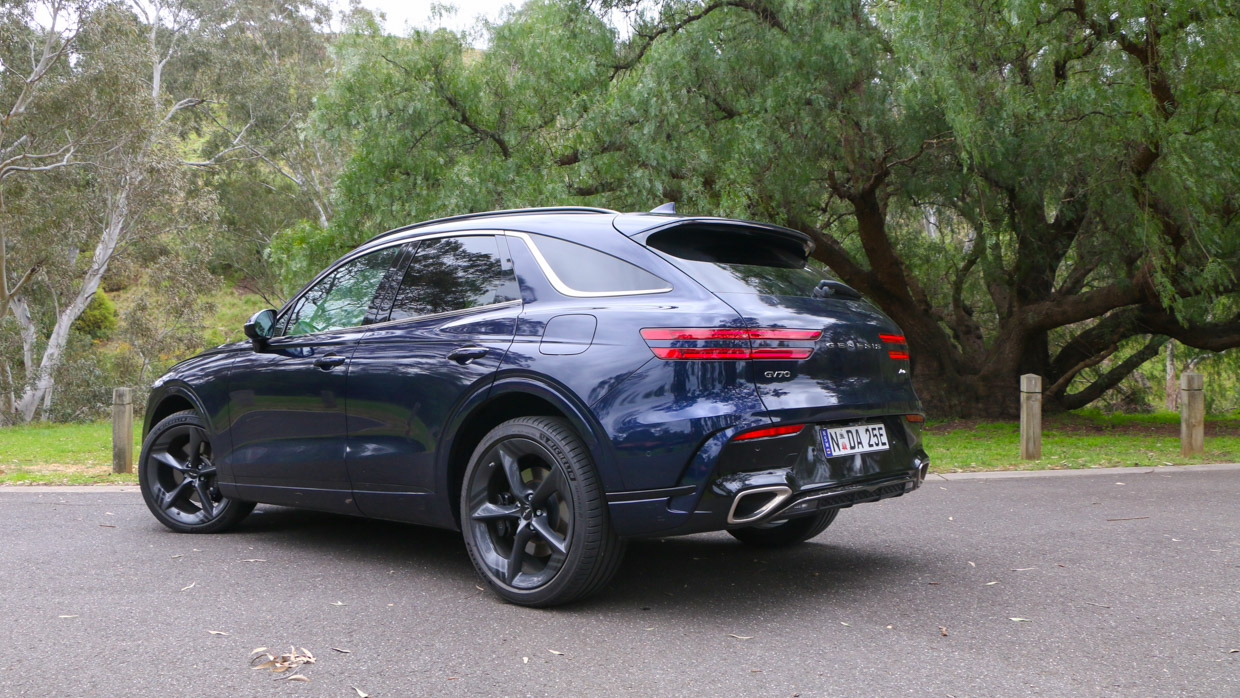
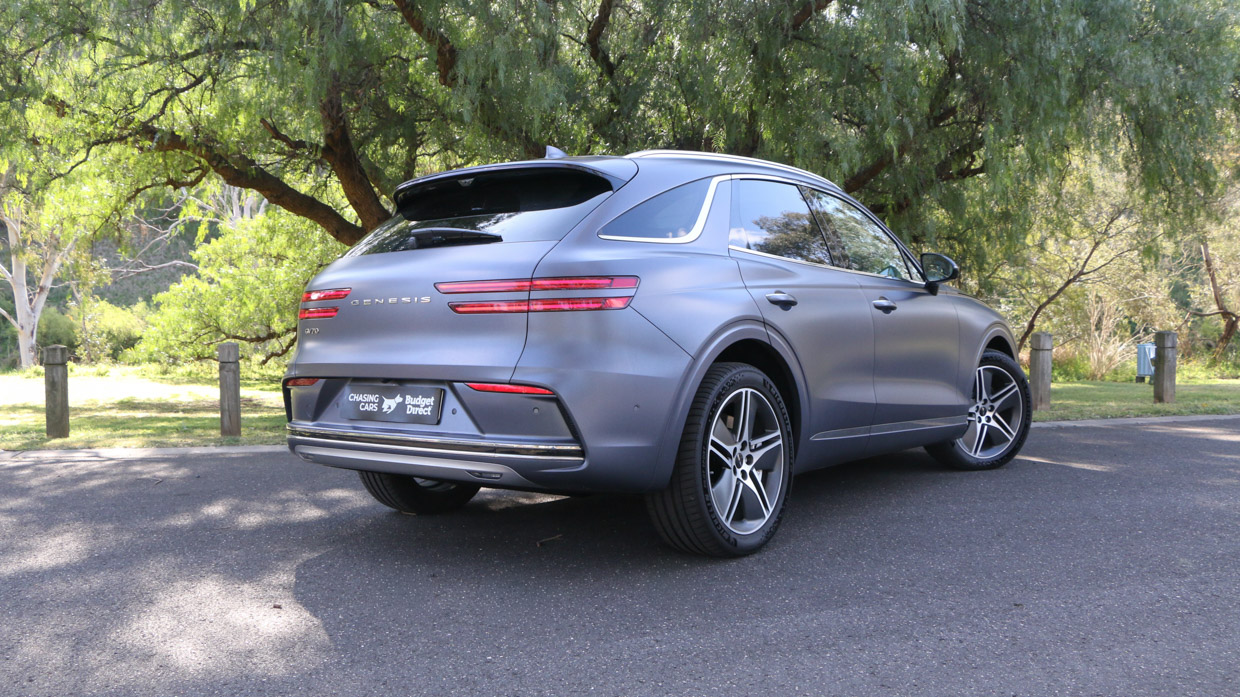
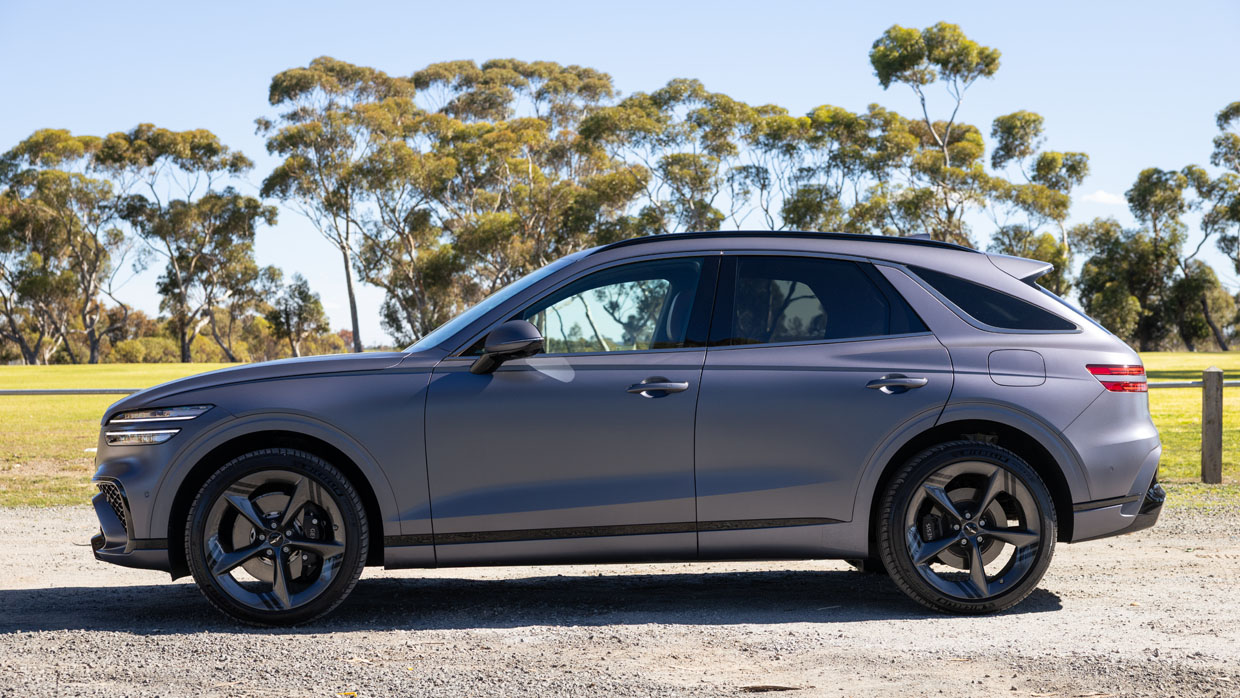
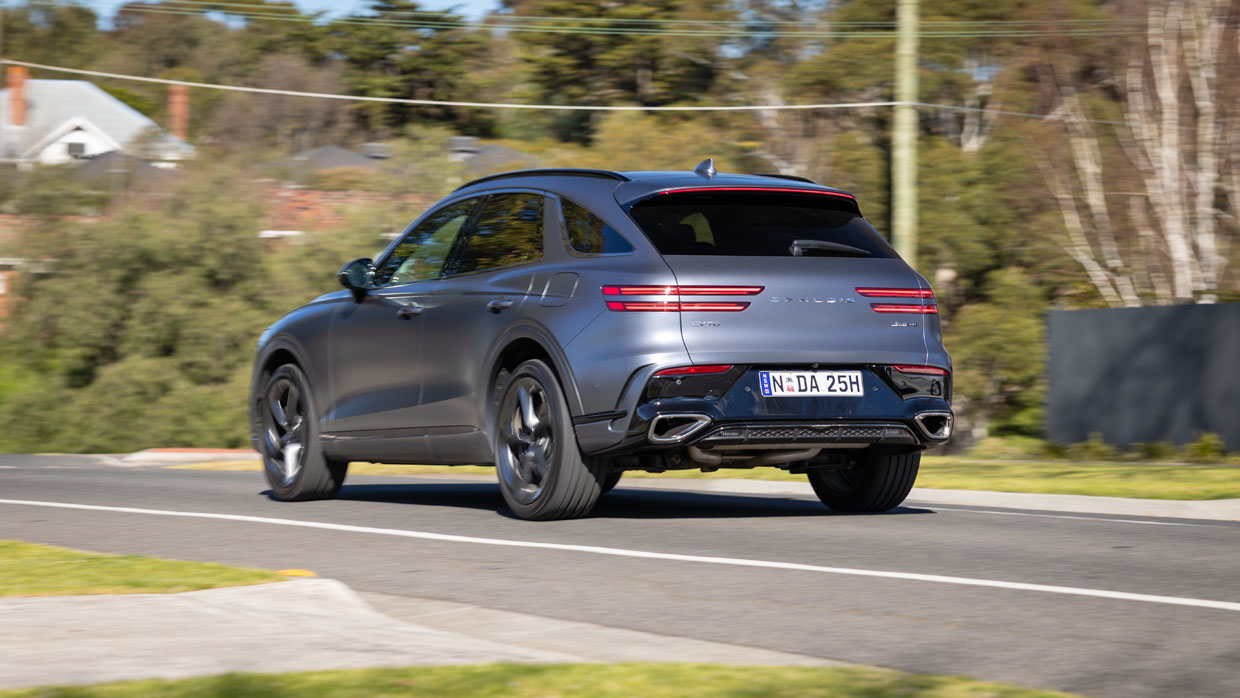
Draped in elegant bodywork, split-LED headlights, 21-inch wheels and matte paint, you could be forgiven for thinking our $110K GV70 would be quietly tucked into the garage every night and brought out only on special occasions.
No such luck for our GV70, I’m afraid. It may be expensive and pretty but it’s also a family SUV – short for sports ‘utility’ vehicle, you may recall – thus, it’s going to be subjected to the unglamorous slog of daily family life.
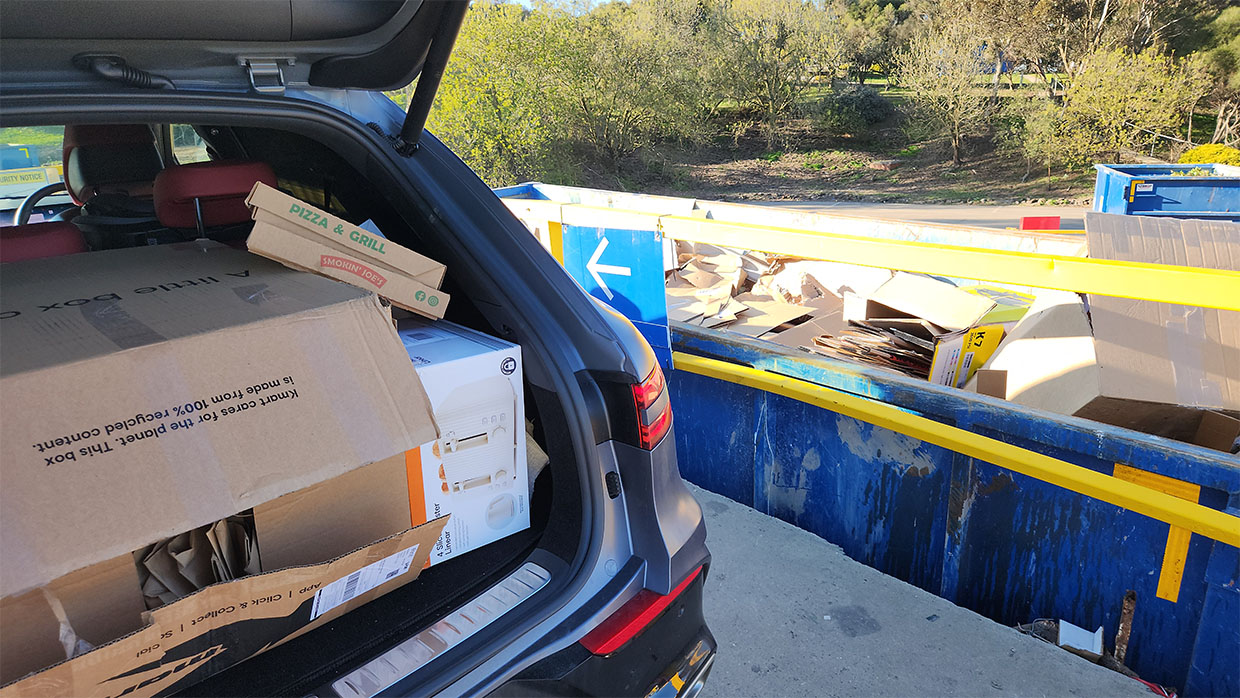
Now bestowed the name of ‘Jenny’ by my three-year-old daughter, our GV70 has completed multiple trips to the dump, an interstate road trip (partially on gravel), and sits out on the street most nights. It has even been hailed on at one point thus far.
So far, it’s done it all without a scratch or complaint. Our Genesis is proving to be a surprisingly practical vehicle.
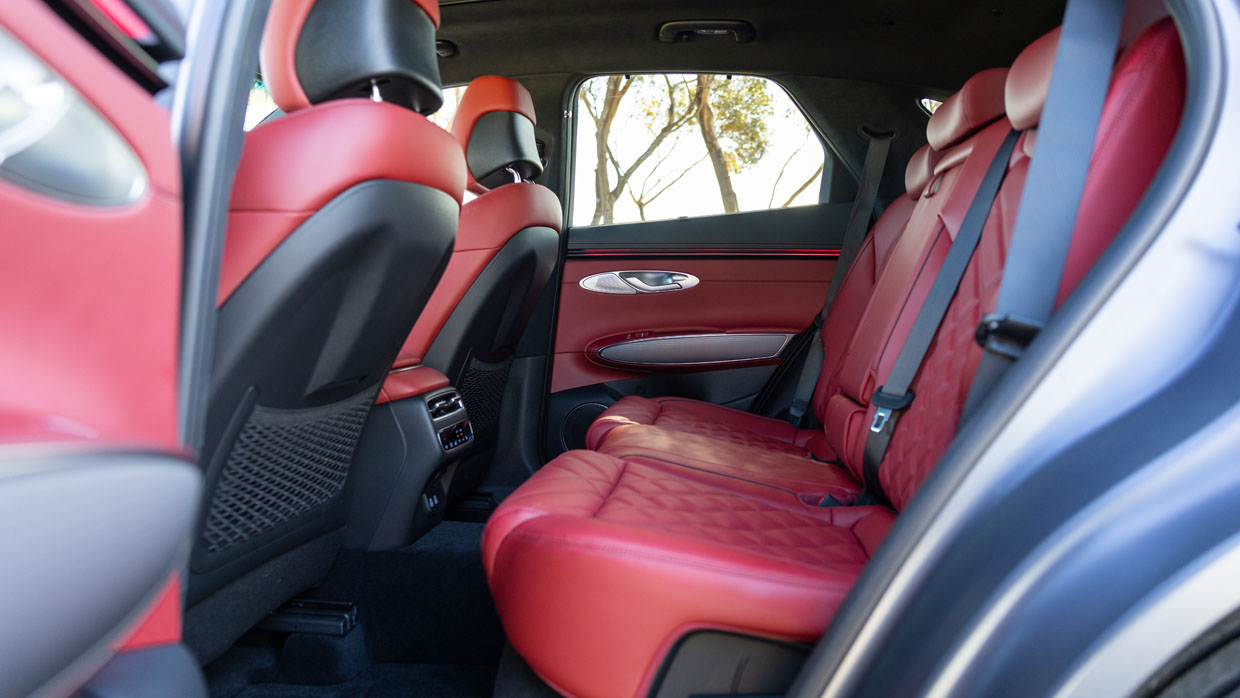
The room up front could be a little better for thick-thighed folk like myself, but second-row space has been well-equipped to handle the fitment of both front- and rearward-facing child seats as part of our daily duties, the latter of which can even be stowed behind my own driving position at 182cm tall.
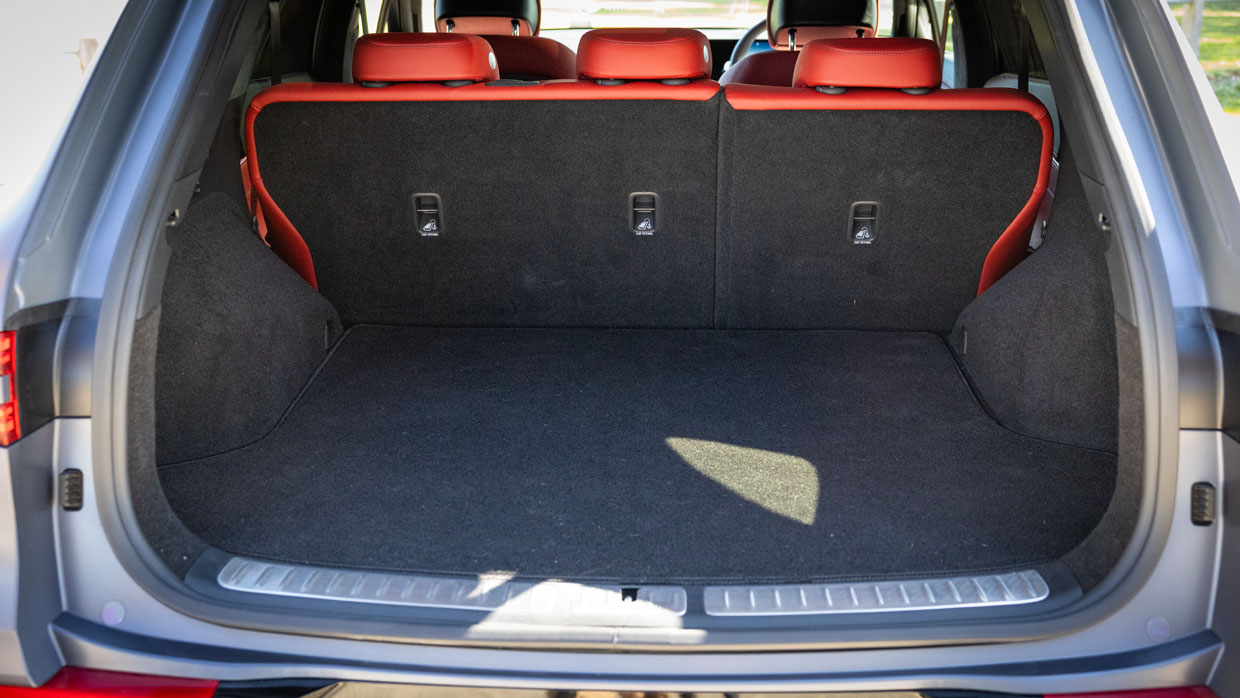
Measuring 542 litres in capacity, the boot is also quite respectable, beating the likes of the Audi SQ5 (520L) though not quite the impressive capacity of the Mercedes-Benz GLC 43 (620L).
The GV70, though, has a party trick most, if not all, performance SUVs lack: a spare.
A spare tyre is an absolute rarity in most cars now, let alone one with performance intentions, but it was a welcome surprise when I looked under the boot floor of ‘Jenny’ for the first time.
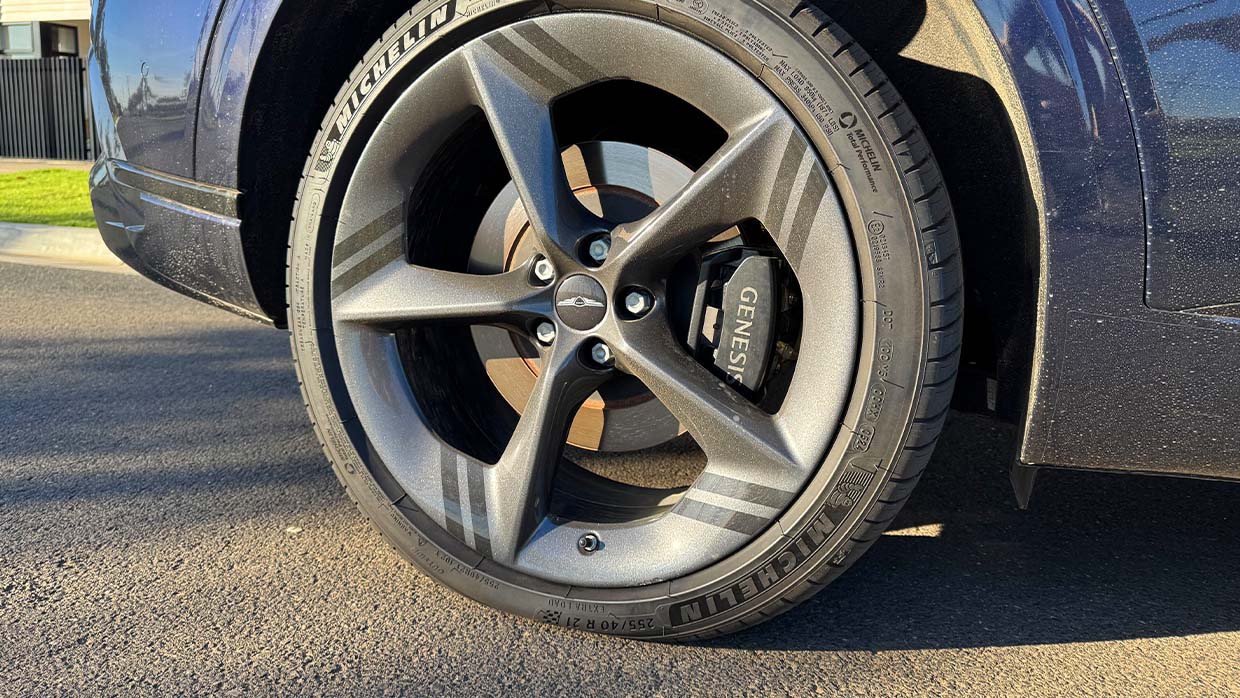
It didn’t take long until I needed it either, upon swapping into the 2.5L four-cylinder version for a week (also fitted with this space-saver spare) I promptly ran over a screw at the beginning of a busy day.
A quick call to Genesis’s roadside assistance crew and the spare was fitted while I continued to bash away at my laptop on urgent matters, allowing me to take the wheel to the shop and get the new tyre fitted to the 2.5T later that day.
It was comforting knowledge that a proper spare wheel sat under the floor as I hopped back into ‘our’ GV70 and embarked on a circa-1600km road trip from Melbourne to Adelaide and back, with my three-year old for company. Not exactly an isolated route, but I wouldn’t be carrying such precious cargo without the safety and security of a spare.
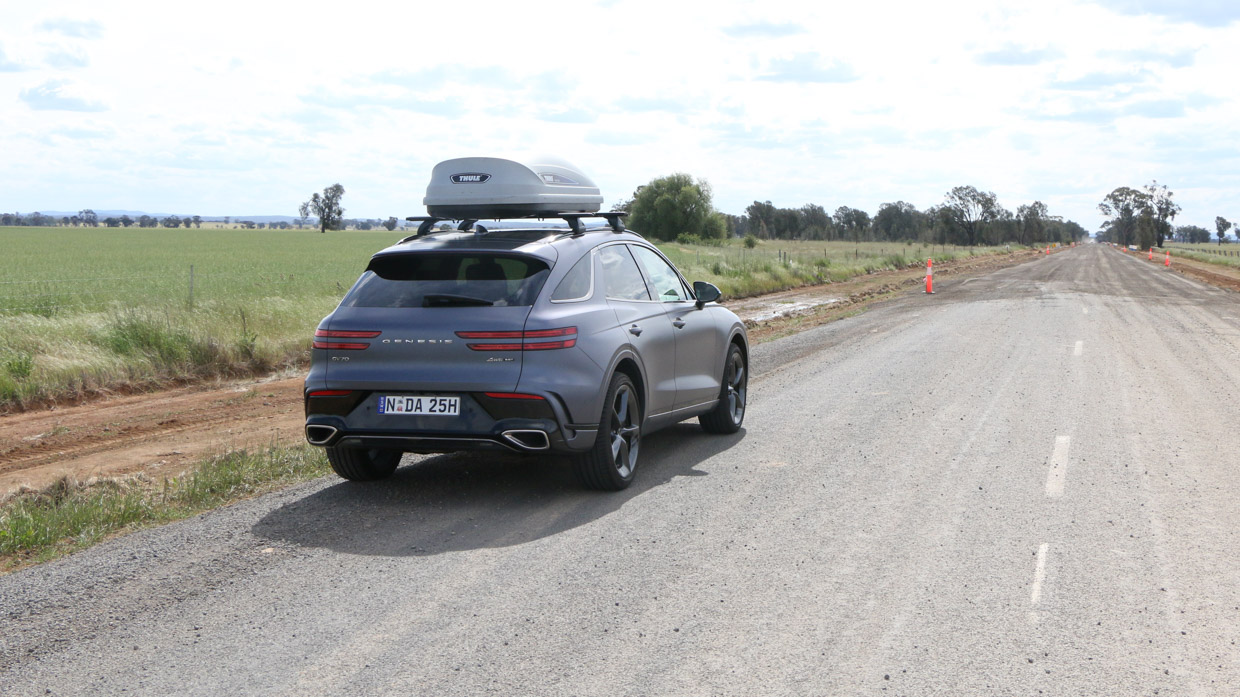
Keen to slice off time before the sun started to fade, I took a detour near Horsham, via the Murra Warra Wind Farm, that saw me travelling for almost a full hour on gravelly, dirt roads at high and low speeds – now a little worried I might be deploying that spare again, sooner than planned.
To my surprise and delight, the Michelin Pilot Sport 4 SUV tyres took the punishment well – as did the matte paint.
Even the suspension was remarkably composed as I worked the wheel to keep Jenny steady while navigating small slides through mushy patches of gravel and long stretches of corrugations.
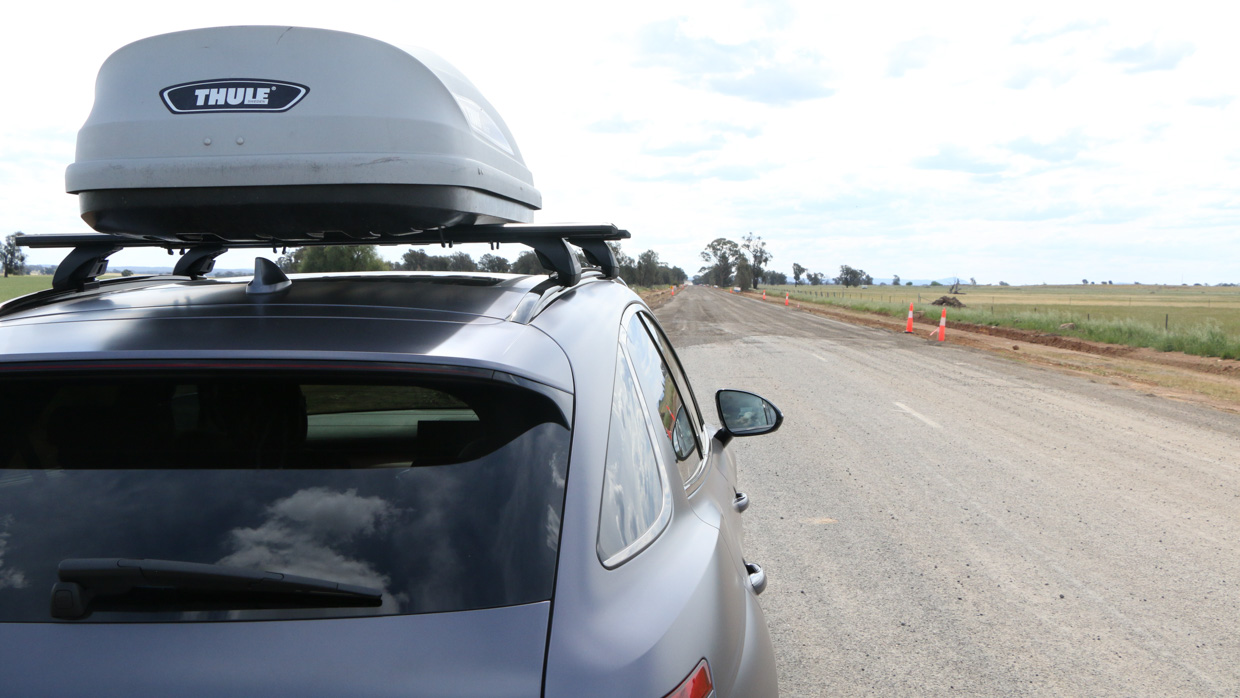
Continuous giggles from the back seat suggest that perhaps daddy ought to behave himself a bit more when driving and teach his daughter the serious nature of our responsibility as drivers, but perhaps that can wait for another day…
As the sky finally turned black and we found our way back onto some tarmac, I started to notice an interesting quirk: the GV70’s adaptive suspension, which works in conjunction with the front camera to scan the road ahead for pot holes, undulations and the like.
Curiously, the ride quality becomes noticeably busier in low-light conditions, something which became quite apparent as I travelled long stretches of unlit rural highway, broken up by brief sections of well-lit towns. Despite the road being largely unchanged in town, the ride was noticeably worse, and there were more suspension quirks to come.
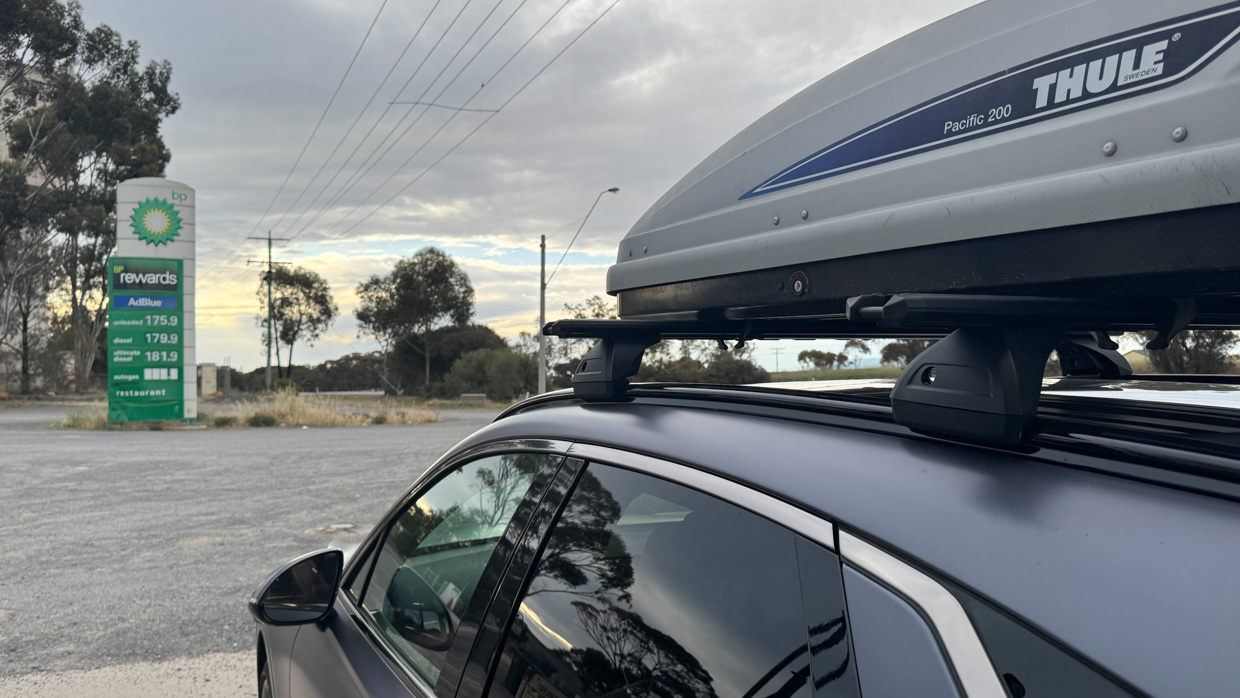
I’d had a set of roof racks installed on Jenny prior to setting off so I could bring my empty roof box along for the ride. The mission? To finally alleviate my dear mother of the crap I’d been storing at her home for about a decade now.
This is to say that the return journey was all together a bit heavier. Books, old Lego, wooden toys and photobooks lined the boot, with a Christmas tree and more books were loaded into the roof box. The GV70 was officially at capacity.
I’d estimate the total payload on board was around 330kg, a fair whack but still 200kg clear of the limit, and the disruption to the ride quality was worse than expected. The effect isn’t catastrophic, but the adaptive suspension doesn’t handle load-lugging as well as it should.
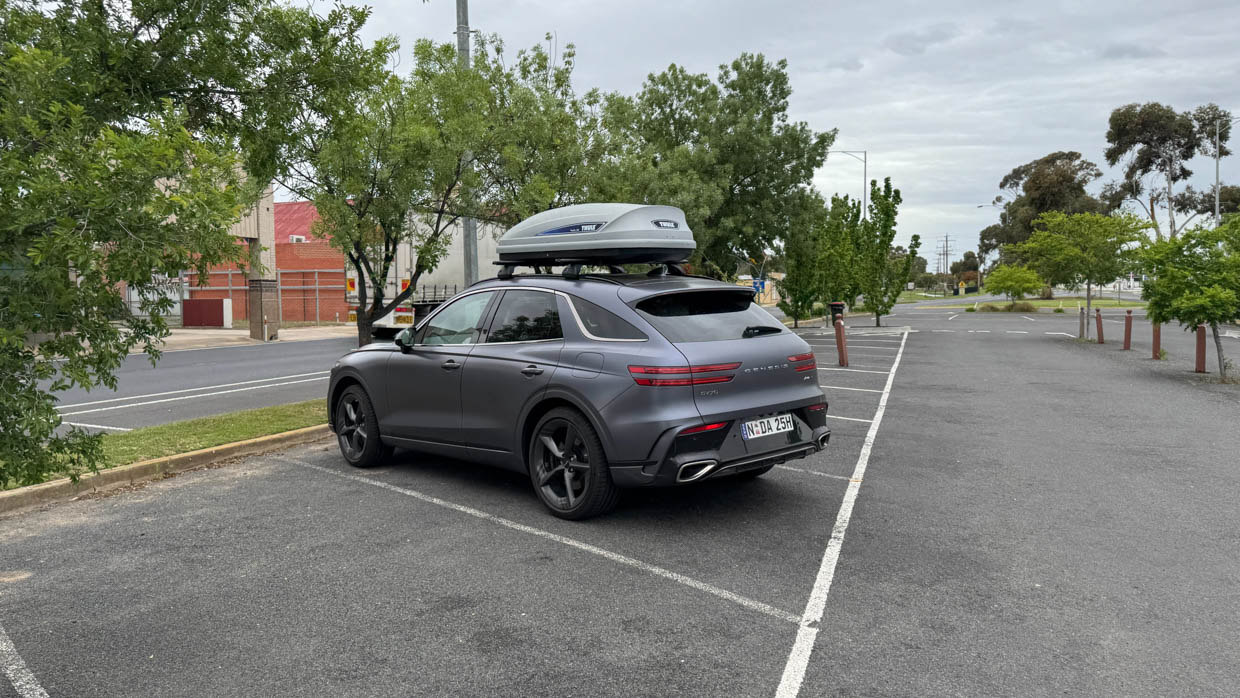
The unladen trip to Adelaide required an average of 10.9L/100km, while strangely the laden return trip to Melbourne 9.8L/100km, possibly due to the slower pace thanks to increased traffic.
A 66-litre tank gives the GV70 a pretty meagre range of around 500-650km on the highway. That V6 sure loves a drink, though you won’t hear me complaining when it’s time to pin the throttle for another overtake…
The GV70, specifically ‘our’ GV70 with its twin-turbo V6, doesn’t officially fall under the category of a fully fledged performance SUV, which on paper might sound a bit silly.
Peak power and torque of 279kW and 530Nm dismiss the yardstick 0-100km/h time in 5.2 seconds, while an LSD and the rear-biased AWD system take care of the twisty stuff.
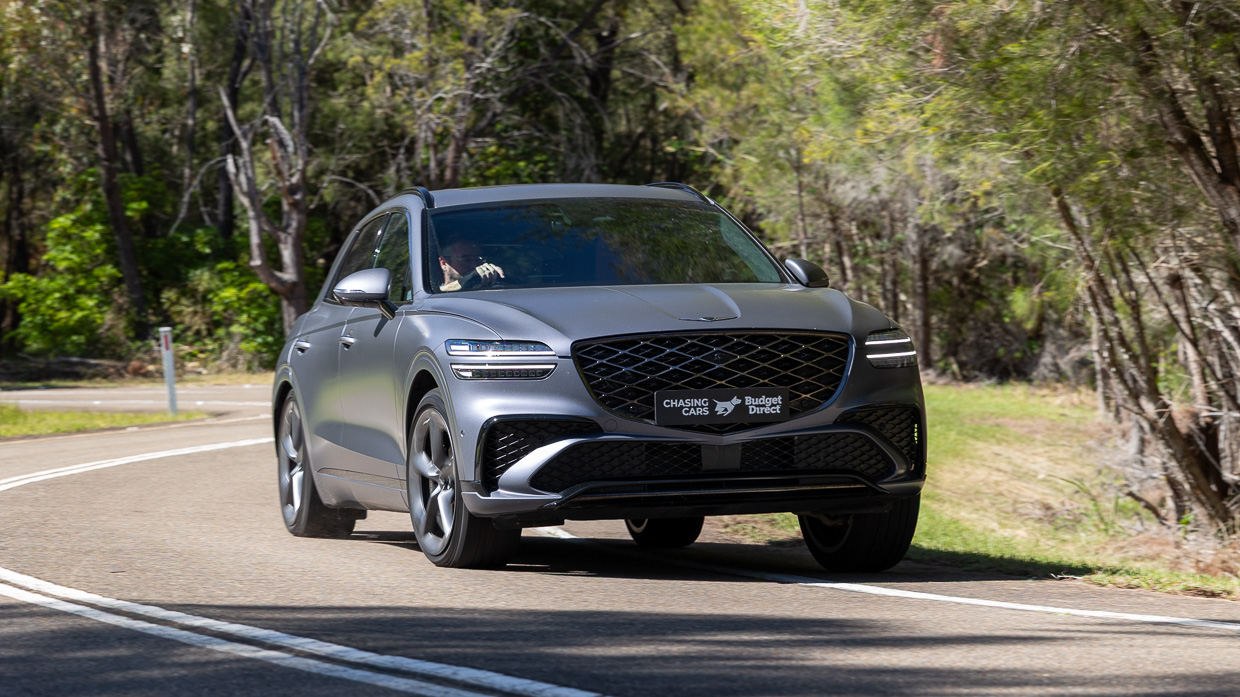
These are perhaps not quite supercar heroics anymore, but they’re enough for me to get excited about prior to getting behind the wheel. And yet our first weeks with the Genesis experience have been, well, a bit slower than we were expecting.
It might be fun to stomp on the throttle in a car with such potential, but that’s something I generally try to avoid when ferrying my toddler and infant daughters to and from daycare, driving past school zones and other pedestrian-heavy areas. This is the sort of driving that dominates the great majority of our lives.
The lazy way the GV70 produces power from its six-cylinder, measuring a decent 3.5-litres in displacement, to spin up the smooth, fluid-based torque converter automatic transmission gives it a beautifully consistent delivery of power.
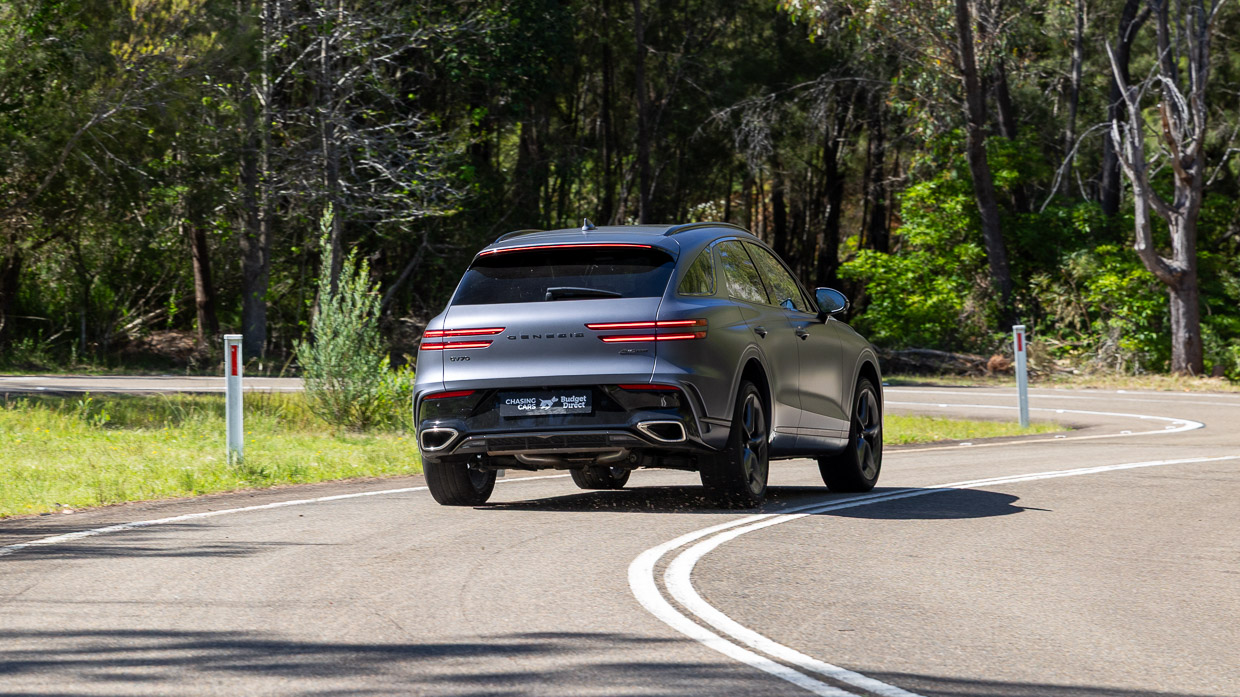
The throttle and brakes are gradual yet progressive in nature, and the absence of a stop-start system makes the switch-over between them at the local roundabout or T-junction delightfully smooth and uninterrupted.
Genesis engineers have clearly put a lot of time and effort into the delicacy of this process, which might just sound like ticking off the basics. But, even in 2025, nailing ‘the basics’ is not necessarily guaranteed.
Not quite hitting the highs of the above but still impressive is the adaptive suspension system that scans the road ahead and is reasonably supple in nature, especially considering the 21-inch wheels fitted at each corner.
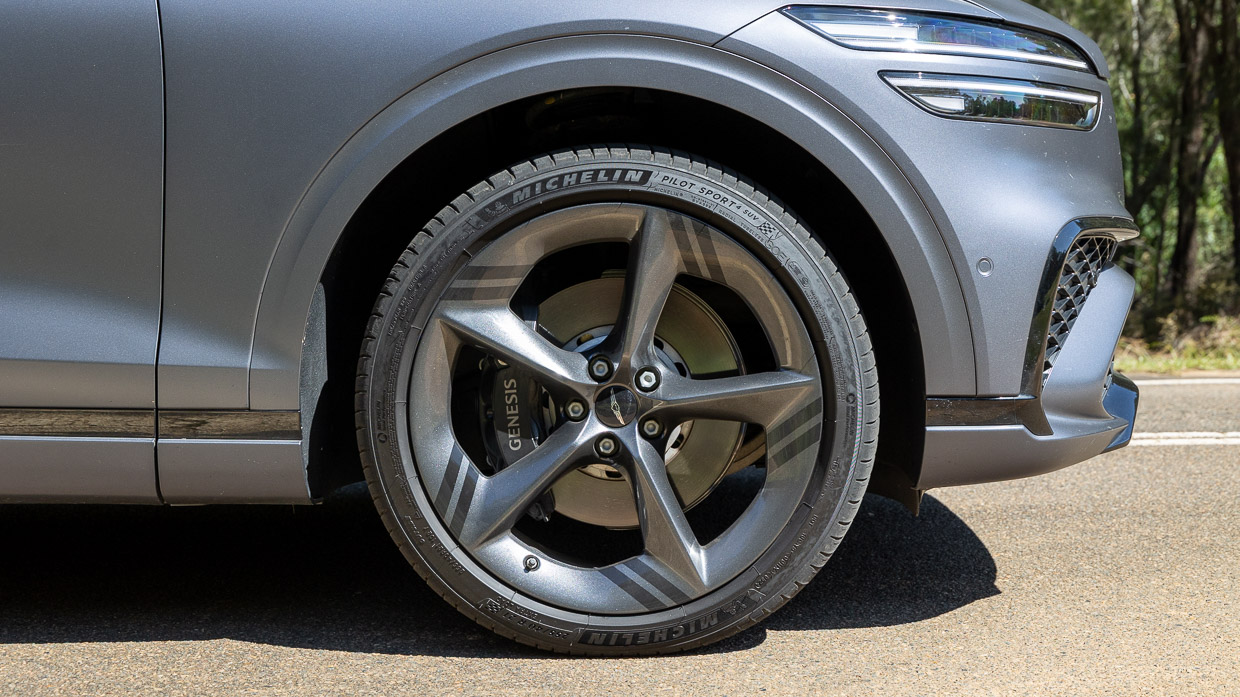
The recent facelift has dialled in the suspension somewhat, which felt overly flaccid and lazy in the default Comfort setting and too hard-edged in Sport, by striking a better middle ground with the former setting. The result is commendably poised and compliant for an SUV with performance intentions.
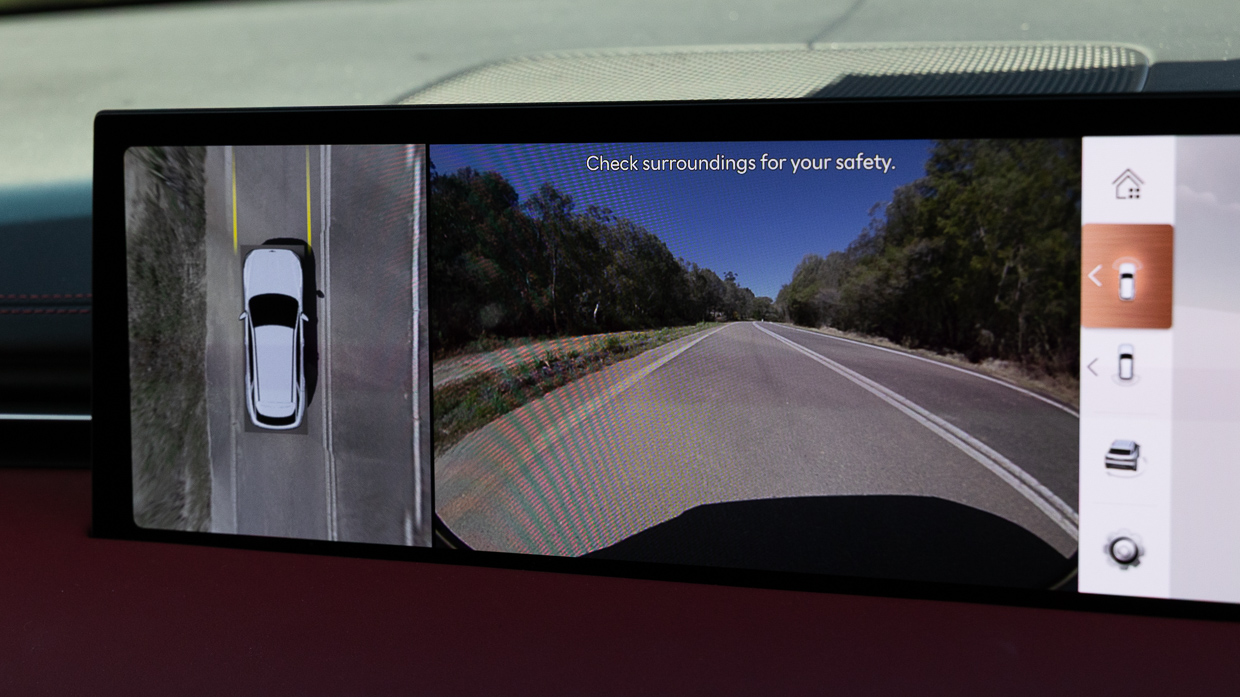
Its urban abilities are complemented by good visibility out of the cabin, backed by an expansive and high-quality camera system, which is an asset when parallel parking under pressure on a busy street.
Again, the basics matter, and so far it’s the basics that have seen me reaching for the GV70 keys almost every day since I’ve had it. As it’s matured, the V6-equipped GV70 now appears to lack any sort of major irritating factor, at least as far as the drivetrain goes.
Genesis still has work to do when it comes to safety systems, which simply lack the tuning and refinement we’ve come to expect from most mainstream vehicles – let alone ones with a luxury pitch and price.
The interventions of lane keep assistance are fussy and unhelpful, making forceful corrections resulting in minimal benefit to our lane position. It’s a trade-off that doesn’t seem worth distracting drivers for when they could already have their eyes on more pressing matters.
We hoped that Genesis would fine-tune its speed monitoring system beyond the performance of a typical Hyundai or Kia, but this too has proved not to be the case.
Every day, the system bleats out a warning like a panicked sheep for wandering ever so slightly over the speed limit. This would be tolerable if the system was actually correct, but it’s not, regularly marking 80km/h zones as 100km/h, and main roads with the 5km/h limit assigned to the car park we’ve long since left.
As a result, turning off these two systems has become a mandatory part of the pre-flight procedure when driving the GV70, which is thankfully a quick and easy process that requires no touchscreen fiddling.
If only the biggest flaws in every car could be turned off at the touch of a button…
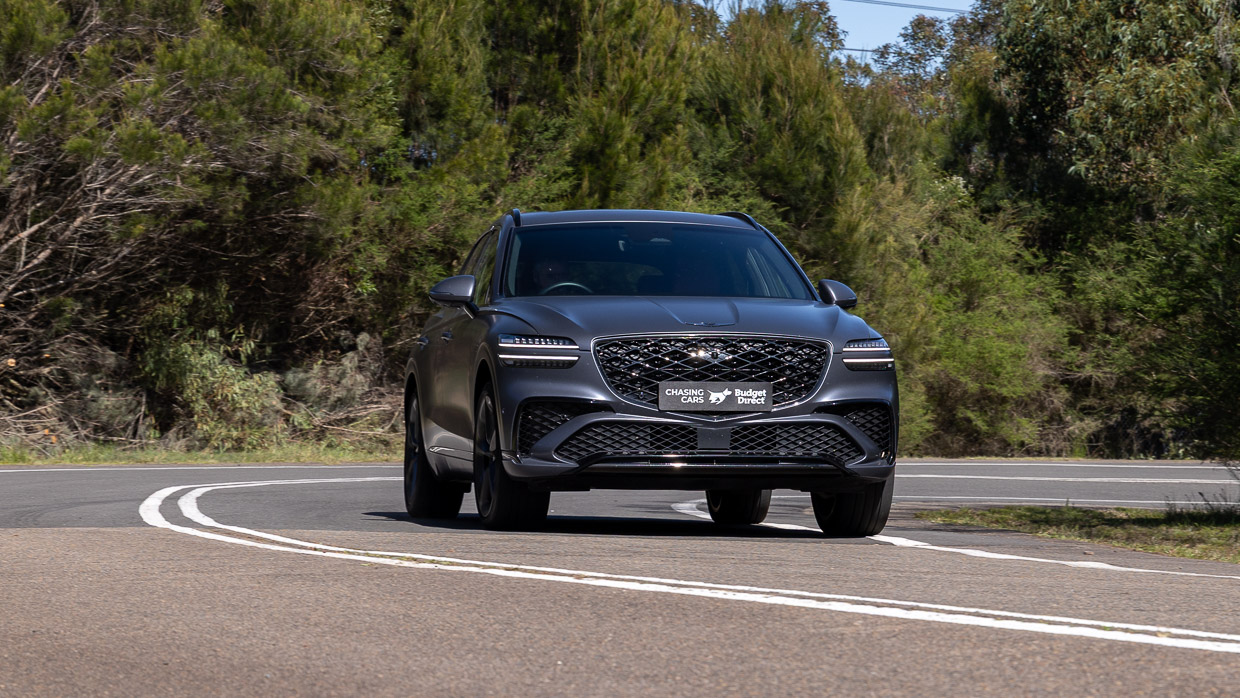
The GV70 midsize SUV first launched locally in 2021. This is the first and only generation so far, though it received a mid-life facelift in Australia at the back end of 2024.
It’s an important vehicle for the Genesis brand as it competes in a highly lucrative segment, against big-hitters like the BMW X3 and Mercedes-Benz GLC.
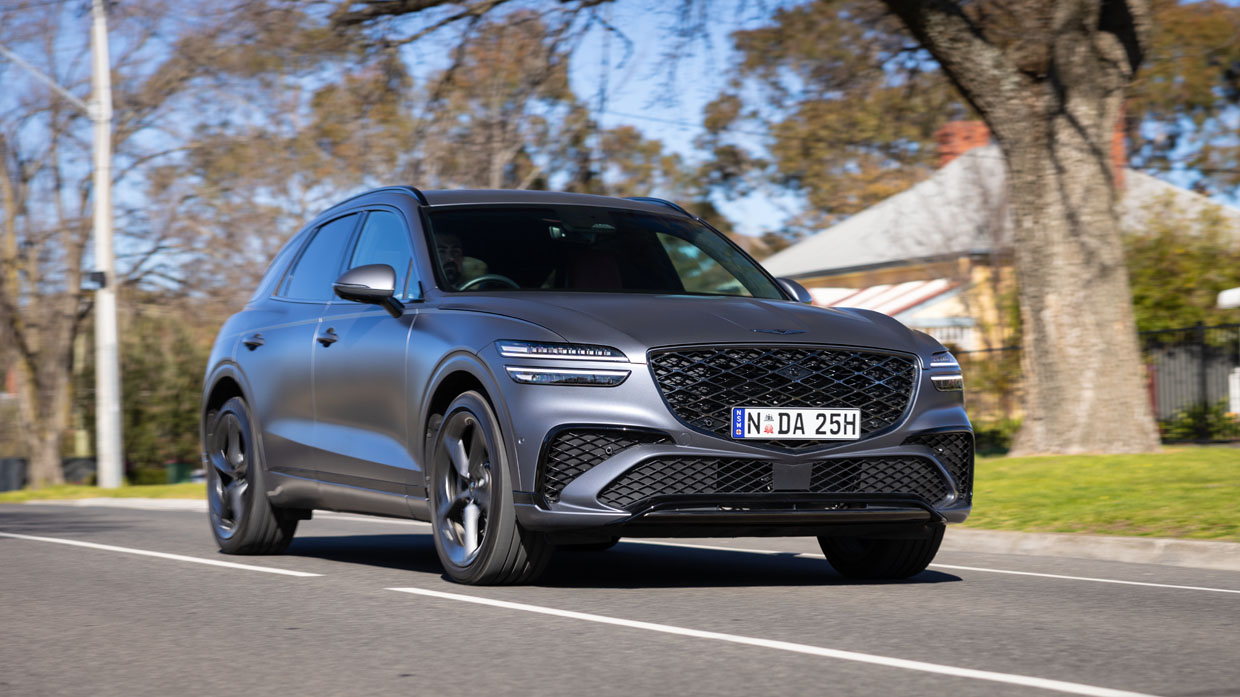
The GV70 starts at $78,700 for the entry-level variant equipped with a 2.5-litre turbocharged four-cylinder engine in ‘Advance’ guise. Buyers can opt for the better-equipped ‘Signature’ for $87,700 or Signature Sport for $89,700.
We’ve opted for a GV70 in Signature Sport guise armed with the V6. It serves as a well-equipped grand touring vehicle with a list price of $100,200. Expensive, but significantly cheaper than high-performance rivals such as the Audi SQ5 ($125,900), BMW X3 M50 ($129,600) or Mercedes-AMG GLC 43 ($136,900).
On the road, our GV70 costs $111,840 when equipped with Makalu Grey Matte paint. It’s the only option on our car, and it costs an extra $2000.
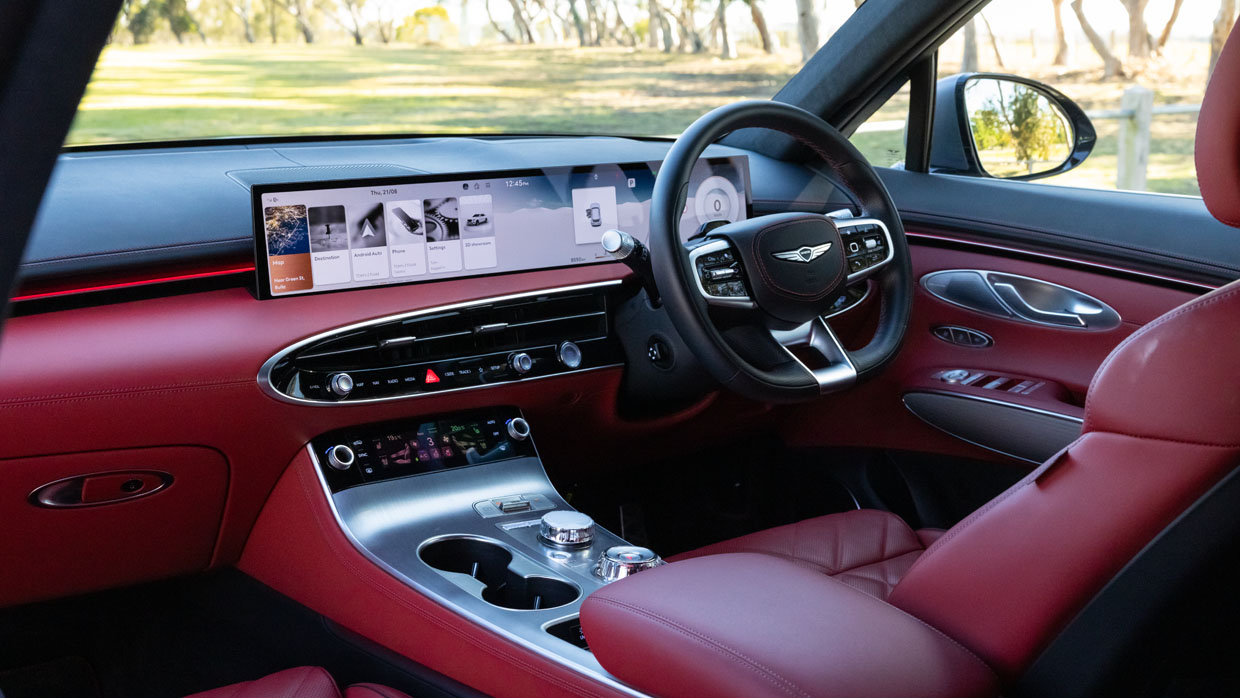
Offer a lot, ask for a little. It’s the playbook of new car brands around the world, and while our circa-$110K GV70 is a very expensive vehicle, it’s certainly very well equipped with the following feature highlights:
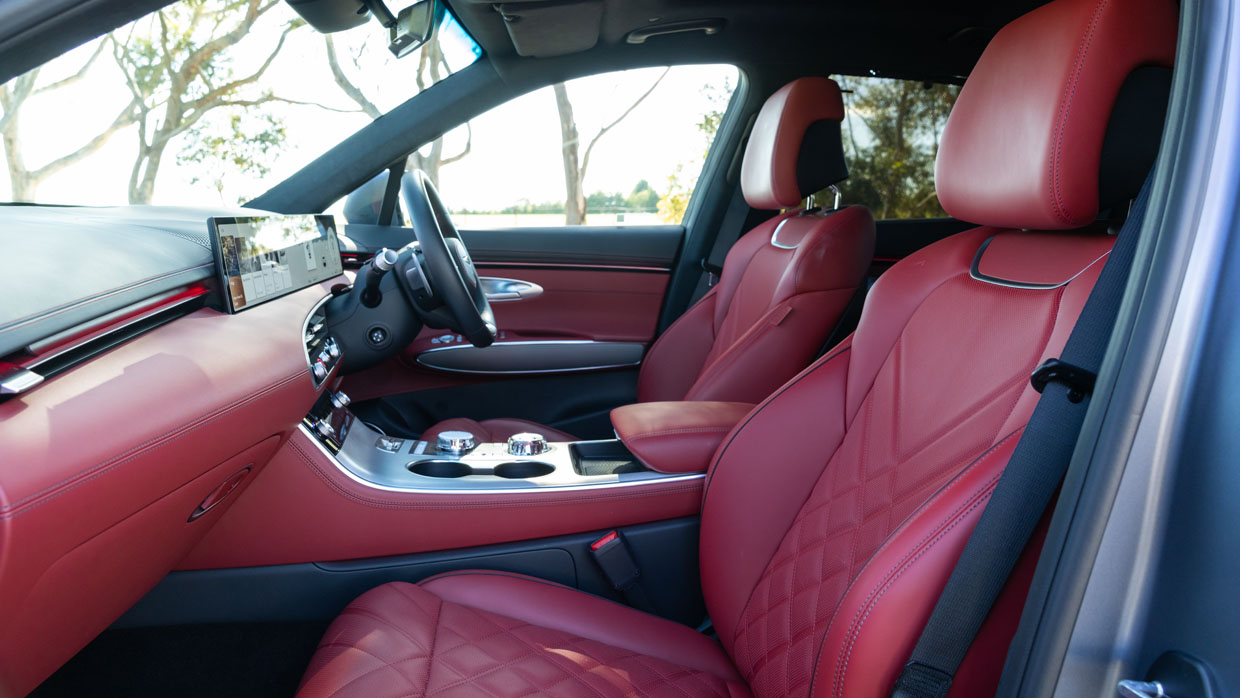
The step up to our ‘Signature Sport’ is primarily a difference of styling and in our eyes, one worth indulging in, with racier 21-inch alloy wheels, a more handsome front-end, dual exhaust tips and a smattering of sporty touches in the interior – such as the alloy finish for the pedals.
It’s not all show without go, however, as the Signature Sport uniquely comes with a ‘Sport+’ model that allows the brave to turn off traction and stability control.
The plan is to hang onto our GV70 for six months. In that time, we plan to put 10,000 extra kilometres on the odometer, which has already endured 6422km of ‘gentle driving’ from other motoring journalists prior to our custodianship.
Practicality is a must for our GV70, which will serve primarily as the everyday commute vehicle for my family of four, including two kids under three.
That means baby seats (forward- and reverse-facing), a pram in the boot, sticky fingers and daily trips to and from their local daycare centre. Plus, whatever else family life throws at us, we never really know….
We’ll also be doing some roadtrips between Melbourne, Sydney and possibly Adelaide to add some kilometres to the odometer and assess its grand touring abilities.
Naturally, there will also be a comparison test against its rivals to discover where it sits in the luxury midsize SUV pecking order.
To make sure we cover off the entire range, we’ll jump into cheaper variants powered by the 2.5L petrol engine and the fully electric version, which is named – would you believe it – the ‘Genesis Electrified GV70’. Bonuses all-round for the marketing team who came up with that…
After nine months of living with utes, first the Mitsubishi Triton and then the Volkswagen Amarok, it was time to shake things up with an altogether different proposition.
In place of Roman-era leaf-spring suspension, our GV70 has adaptive dampers paired with a camera that scans the road ahead to detect imperfections and react accordingly.
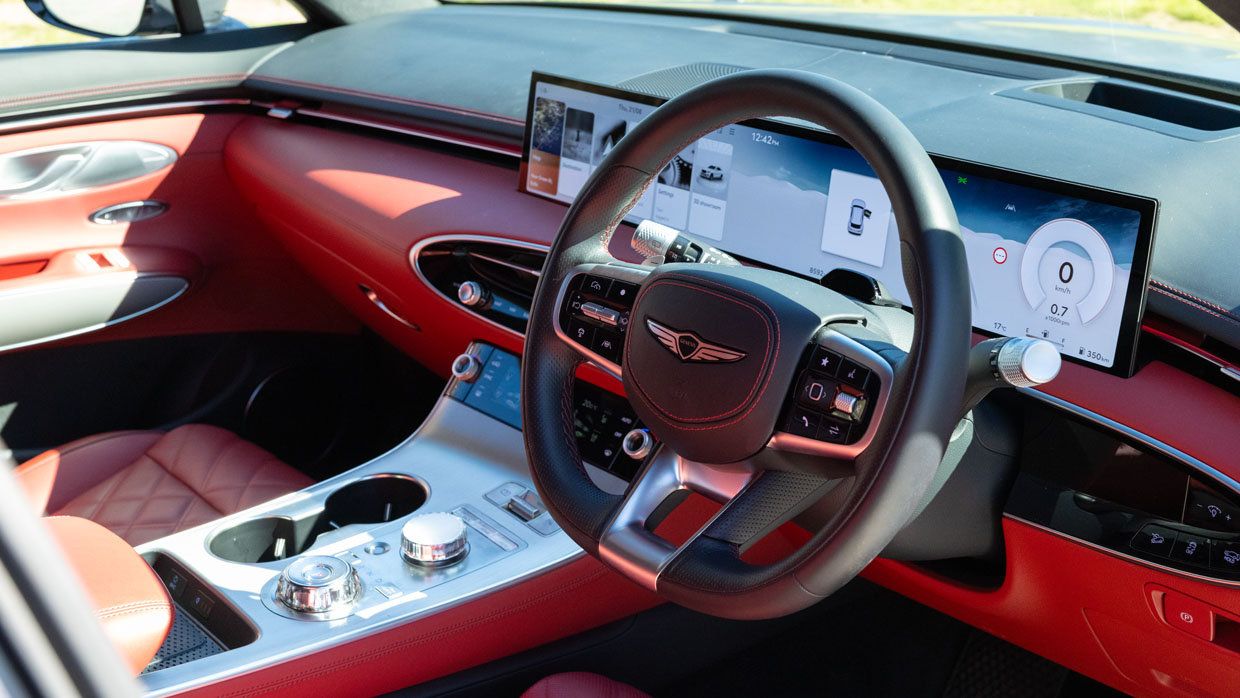
In place of 9.0- or 12.0-inch touchscreens, we have a whopping 27.0-inch widescreen that sweeps across the dash – itself clad in rather lovely red leather.
In place of diesel-clatter, we have a twin-turbo V6 petrol engine plying 279kW and 530Nm of torque to the road in a polite, yet savage manner.
Point being: it’s time to pop in my monocle, pretend I’ve jumped up a few tax brackets and settle into the luxury language for the next six months and 10,000km.
This sort of chopping-and-changing is a common part of motoring journalism but living with a luxury vehicle for half a year is quite rare, and given the miserable reputation some high-end vehicles carry for long-term reliability, I was a bit concerned…
‘Owning’ a vehicle with infamously sensitive matte paint has renewed my hatred of birds and while the clever suspension system might be scanning the road ahead, one look at the potholes in my area and the only message it will be sending back to the dampers is ‘brace for impact’.
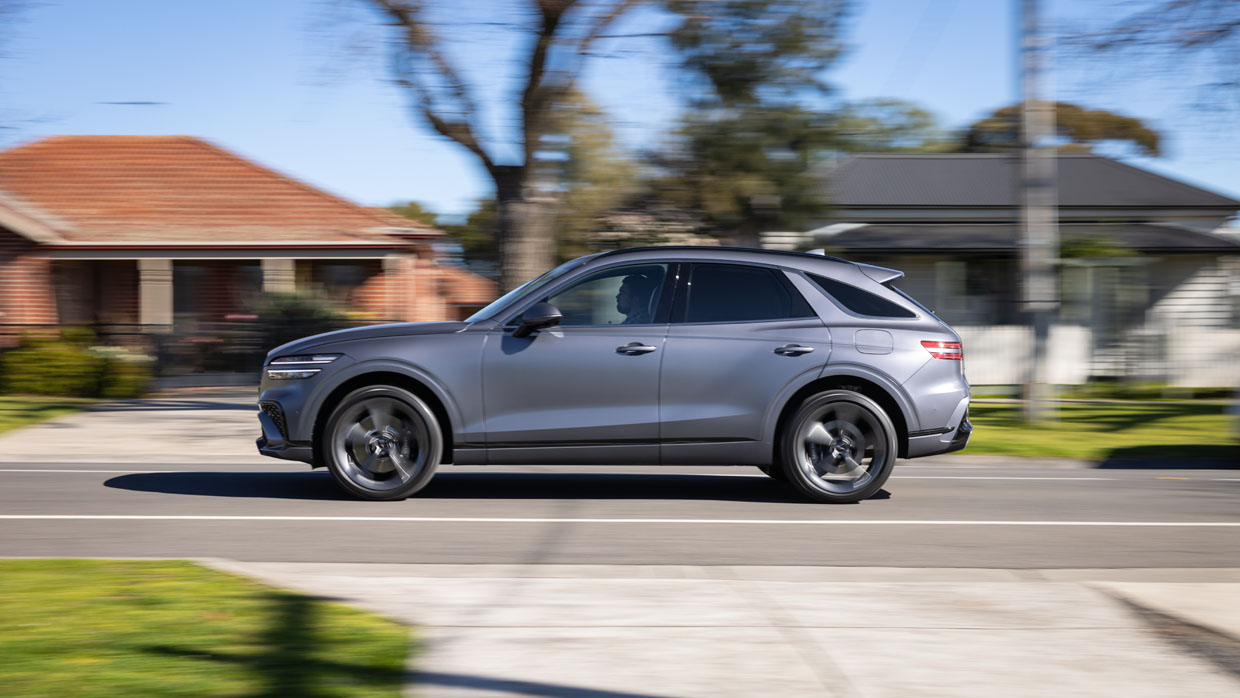
Those 21-inch wheels wrapped in 255/40 Michelin Pilot Sport4 SUV tyres are in for a fight, but to their credit, my initial experience has been quite positive, and I was both delighted and surprised to discover a space wheel under the boot floor of our GV70 if anything goes awry.
While some might snicker and call it the ‘Kia Stinger’ engine, the 279kW/530Nm 3.5-litre twin-turbo V6 engine is a mighty thing to drive every day, and the GV70 very much conveys a sense of budget Porsche Macan vibes with the way it drives. That’s no criticism, that’s praise to the highest degree.
It comes at a cost, however, as the big V6 loves a drink. So far, we’ve recorded consumption of around 12L/100km using 98 Ron fuel exclusively, driven primarily in urban areas.
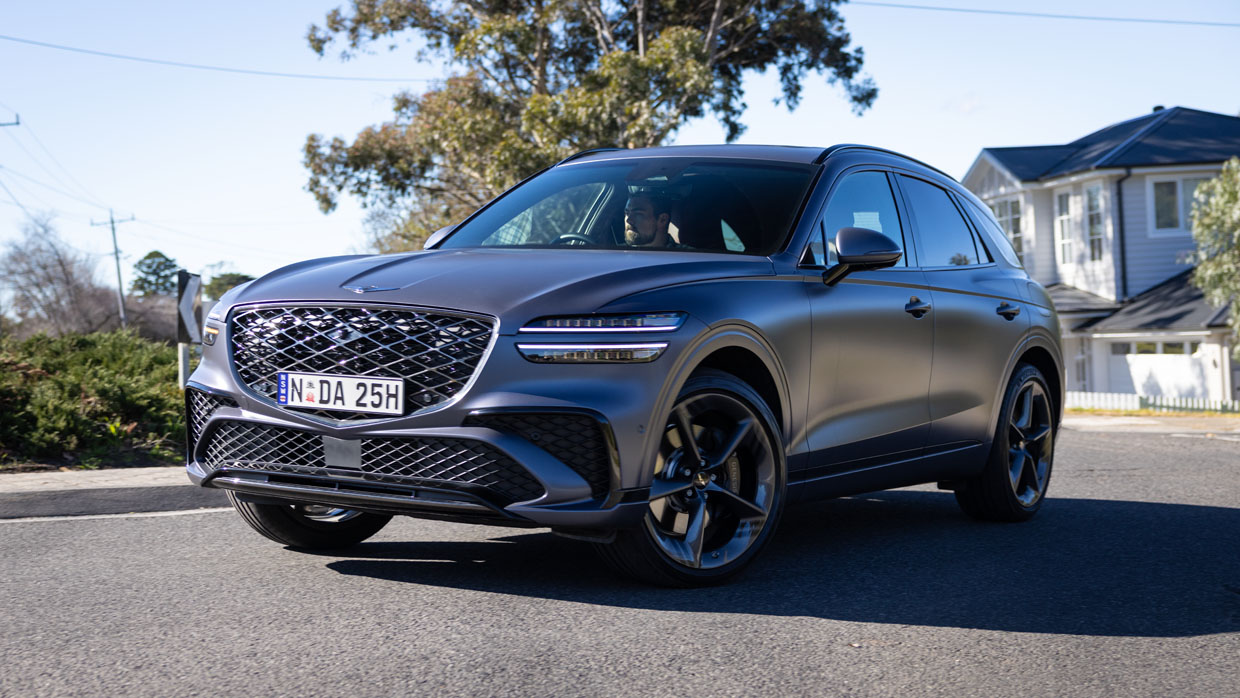
We plan on doing more highway miles to provide a more accurate figure across a range of conditions, but even the 11.3L/100km rating is significantly higher than rivals such as the BMW X3 M50 (8.2L/100km) and Audi SQ5 (7.6L/100km), which offer similar performance.
We’ll keep an eye on fuel consumption, but it’s otherwise, so far, so good for the GV70, but time will always tell and we have a lot of time….
About Chasing cars
Chasing Cars reviews are 100% independent.
Because we are powered by Budget Direct Insurance, we don’t receive advertising or sales revenue from car manufacturers.
We’re truly independent – giving you Australia’s best car reviews.
The estimate provided does not take into account your personal circumstances but is intended to give a general indication of the cost of insurance, in order to obtain a complete quote, please visit www.budgetdirect.com.au. Estimate includes 15%^ online discount.
^Conditions Apply
Budget Direct Insurance arranged by Auto & General Services Pty Ltd ACN 003 617 909(AGS) AFSL 241 411, for and on behalf of the insurer, Auto & General Insurance Company Limited(ABN 42 111 586 353, AFSL 285 571).Because we don’t know your financial needs, we can’t advise you if this insurance will suit you. You should consider your needs and the Product Disclosure Statement before making a decision to buy insurance. Terms and conditions apply.
Indicative quote based on assumptions including postcode , 40 year old male with no offences, licence suspensions or claims in the last 5 years, a NCD Rating 1 and no younger drivers listed. White car, driven up to 10,000kms a year, unfinanced, with no modifications, factory options and/or non-standard accessories, private use only and garaged at night.
^Online Discounts Terms & Conditions
1. Discounts apply to the premium paid for a new Budget Direct Gold Comprehensive Car Insurance, Third Party Property Only or Third Party Property, Fire & Theft Insurance policy initiated online on or after 29 March 2017. Discounts do not apply to optional Roadside Assistance.
2. Discounts do not apply to any renewal offer of insurance.
3. Discounts only apply to the insurance portion of the premium. Discounts are applied before government charges, taxes, levies and fees, including instalment processing fees (as applicable). The full extent of discounts may therefore be impacted.
4. We reserve the right to change the offer without notice.