Powered by

-
Car Reviews
Latest reviews
-
Car News
Latest news
-
Car Comparisons
Latest comparisons
- Chasing Deals
Latest reviews
Latest news
Latest comparisons
Local Kia executives want to bring the EV2 to Australia, but there are concerns that it would not be meaningfully cheaper than the EV3 if the dollar does not strengthen
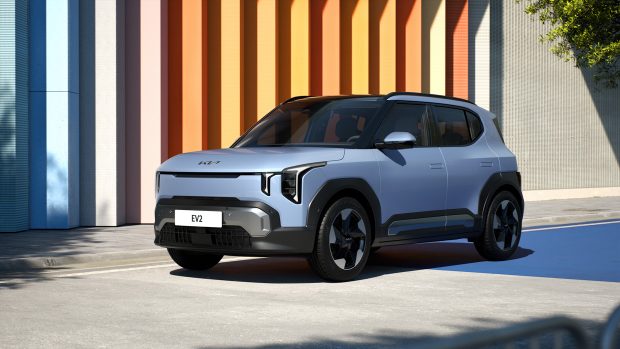
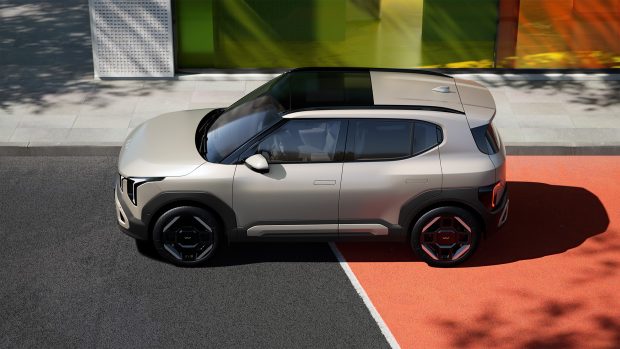
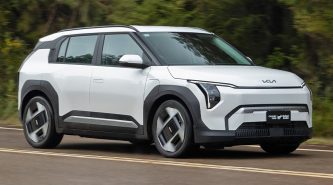
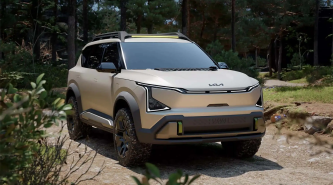
The Kia EV2 was revealed this evening at the 2026 Brussels Motor Show as the South Korean manufacturer’s sixth dedicated battery electric (BEV) model — and its cheapest, most affordable EV yet for global markets.
Kia says it is focussing on bringing new customers to the brand via the EV2 — in particular, people purchasing their first fully electric vehicle.
But the question of whether the Slovakian-built EV2 will be launched in Australia remains unresolved due to currency pressures caused by the strength of the Euro, with the model remaining “under study for Australia” according to a spokesperson.
“The currency is not great — the Euro to the Aussie dollar — and that is not something you can easily just turn around,” Kia Australia general manager of product planning Roland Rivero told Chasing Cars last month.
“We have to be mindful that if EV2 comes in at the same price as EV3, as a worst case, it doesn’t really make any logical sense in the marketplace when you have a [BYD] Atto 1 or Atto 2 in the $20,000s and $30,000s.
“I think the maths at the moment are questionable,” said Rivero in December 2025. The relative strength of the Euro to the Australian dollar has persisted since April 2025.
A final decision will be made soon by Kia Australia, with entry-level versions of the EV2 slated to go into production by the end of March 2026.
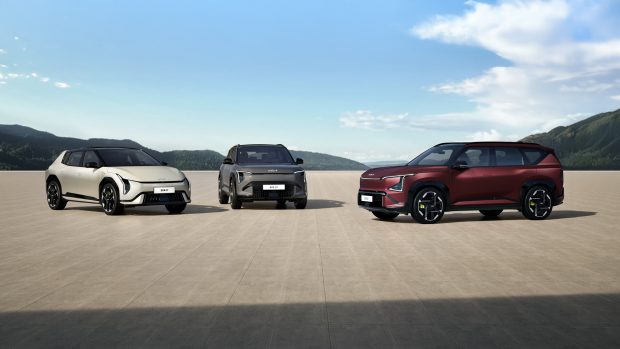
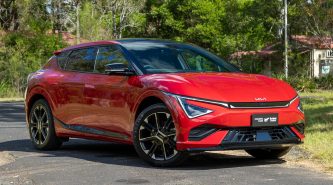
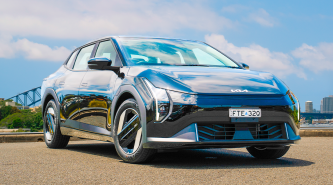
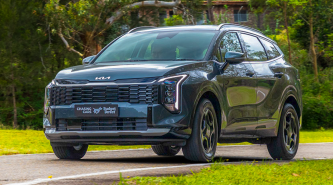
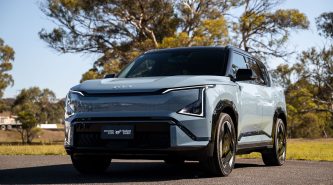
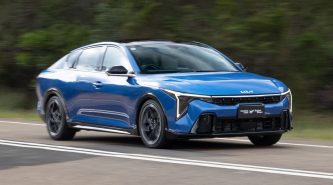
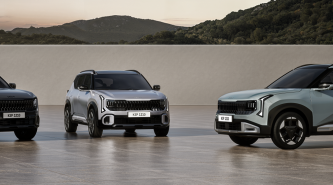
Three other variants revealed by Kia at the Brussels show — high-powered GT versions of the EV3, EV4 and EV5 — are understood to be less likely to come to Australia.
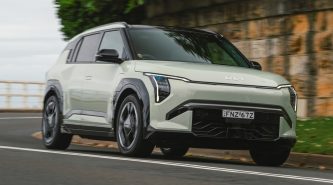
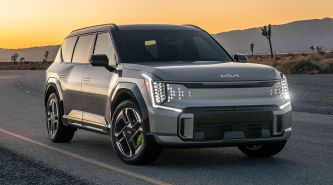
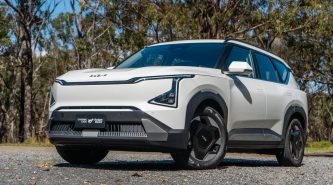
The EV2 is intended to slot into Kia’s small SUV lineup beneath the EV3 (which is priced from $47,600 plus on-road costs in Australia) and as a BEV alternative to the petrol-powered Stonic (from $28,180 + ORCs).
That positioning makes sense given the EV2’s compact dimensions which measure 4060mm long, 1800mm wide and 1575mm high on a 2565mm wheelbase, with weight expected to be around 1650kg.
Kia is also leaving room beneath the EV2 for a Picanto-sized EV1 hatchback.
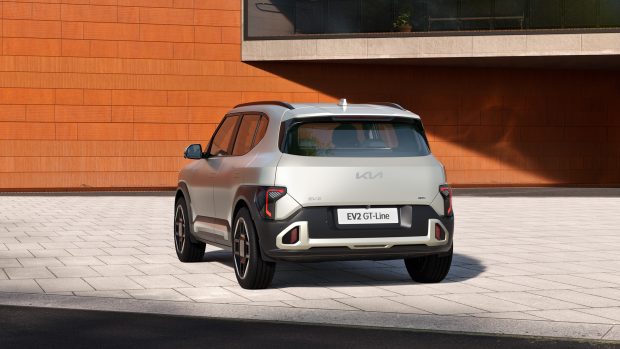
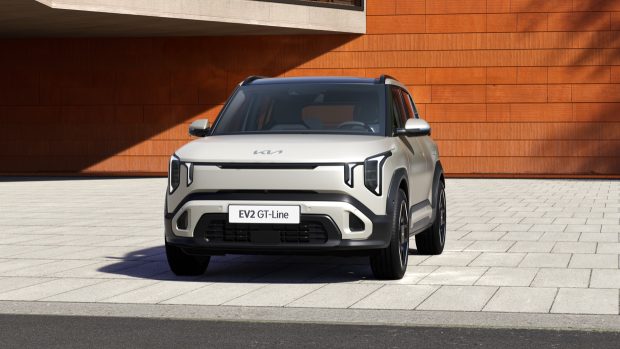
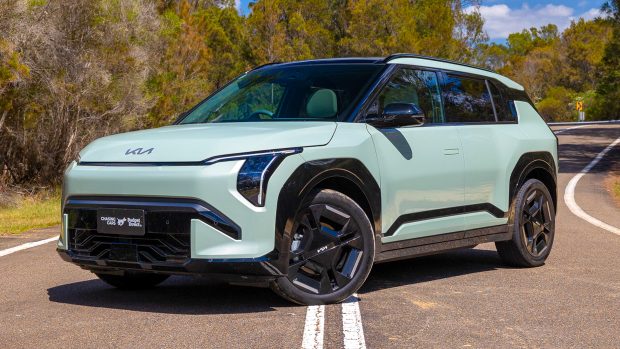
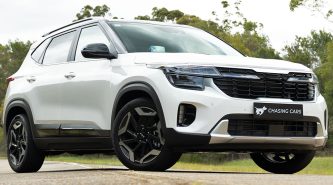
Outside, an updated interpretation of Kia’s ‘Opposites United’ design language incorporates Star Map lighting first seen on the second-generation Seltos SUV, prominent plastic cladding and a breadvan-like stance intended to maximise interior space.
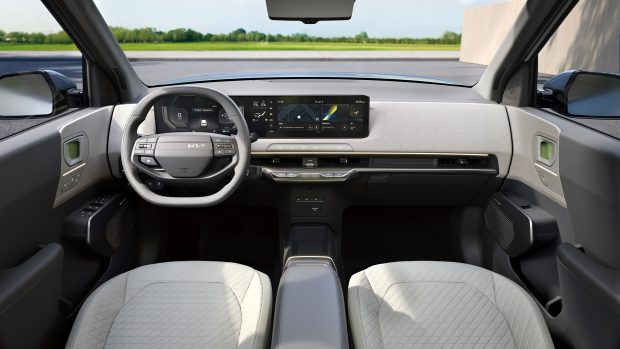
The cabin philosophy — dubbed “Picnic Box” — looks to have resulted in one of the entry-level BEV segment’s most pleasant interiors, featuring a wraparound fabric crash pad, dual 12.3-inch infotainment screens, and solid integration of physical shortcuts for key controls.
Standard and GT-Line grades will be available with premium options set to include a Harman-Kardon stereo, a sunroof, and 100-watt USB-C charging capability, while car connectivity (including digital key, smartphone app and over-the-air updating) will be fitted.
The ccNC infotainment system will also incorporate a new pet mode to keep animals cool in the car, as well as EV-specific route planning with Plug & Charge capability for supported charging network billing.
Boot space is claimed to be “up to” 403 litres in four-seat format, but Kia Australia would likely opt for the five-seat version which involves a reduction in boot capacity to 362L. Kia says the EV2 has a “class-leading” frunk.
We know there will be both Standard Range and Long Range versions of the EV2, making use of 42.2kWh and 61.0kWh batteries — of unknown chemistry — respectively. Kia usually quotes total battery size, so usable capacity will likely be a touch lower.
WLTP range is claimed to be 317km for the Standard Range and 448km for the Long Range, while GT-Line — expected to be Long Range only and riding on 19-inch wheels — will likely provide around 420km range.
Like other Hyundai and Kia EVs that skip the ‘full-fat’ version of e-GMP, fast-charging performance looks mediocre, with a 29 to 30 minute 10-80 percent recharging claim indicating average charging speeds of 59kW (Standard Range) or 85kW (Long Range).
More impressive is that a 22kW onboard AC charger will be available for quick home or office charging potential.
Other affordability measures include the use of a rear coupled torsion beam axle (with hydro bushings) in place of multi-link independent rear suspension, though steering should benefit from use of a column-mounted motor.
Like the EV3 with which it shares its affordable fork of Kia’s e-GMP BEV platform, the EV2 is front-wheel drive but power, torque and acceleration figures have not yet been disclosed.
Safety features will take in strong lane keeping assistance with steering hands-on detection, forwards and reversing AEB, adaptive cruise control, a 360-degree camera, and blind spot view cameras.
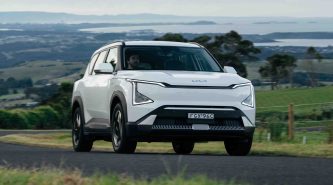
Some of Kia’s electric models have been relatively successful in the Australian market and key executives say they were content with the sales performance of the EV3 small SUV and EV5 midsize SUV last year.
That pair — which, like the EV2, come from the affordable fork of Kia’s BEV platform — sold 2597 and 4787 units respectively in Australia last year.
The contribution of the EV3 and EV5 to Kia’s total result was much higher than the higher-tech EV6 (348 units) and EV9 (269 units) which the South Korean brand continues to position as brand flagships.
Latest news
About Chasing cars
Chasing Cars reviews are 100% independent.
Because we are powered by Budget Direct Insurance, we don’t receive advertising or sales revenue from car manufacturers.
We’re truly independent – giving you Australia’s best car reviews.